IADC vs. IWCF Certificates: What are the Differences

Written By: Computer Science Professor
Deeply rooted in the R&D of simulators for the oil and gas industry, committed to bringing safety to every oil worker.
In the oil and gas industry, well control training and certification are kinda essential for making sure drilling and production stay safe. Like, well control isn’t something you can improvise. Two of the most recognized well control certification systems worldwide are the IADC WellSharp certification and the IWCF Well Control certification. Both of these programs aim to boost personnel competency, lower well control risks, and set standardized training requirements for different workplace situations. Still, they are not the same. They come from different organizational backgrounds, the training is structured a bit differently, and the assessment methods vary, and how they are typically used across the industry.
If you understand the differences between the IADC and IWCF certificates, it becomes easier for drilling contractors, operators, and oilfield professionals to choose what fits. That choice depends on your specific job role, local or regional requirements, and also company policies, because each operator sometimes wants a particular approach or emphasis.
The Basics of IADC and IWCF Certifications
The International Association of Drilling Contractors (IADC), is a worldwide group that represents companies plus professionals tied to drilling operations. Their well control certification program called IADC WellSharp was put together so training could be competency-based, and it is aimed at drilling people like drillers, supervisors, and also well site leaders, who are on the ground.
The International Well Control Forum (IWCF), is an independent nonprofit that was set up to encourage well control capability and safety standards around the world. Their certification tracks tend to look at both what someone knows and the practical know how needed for well control work, across drilling, completions, and intervention type activities.
In practice, both certifications tend to be widely accepted by oil and gas companies, and they show up often as a requirement for personnel working on offshore platforms, land rigs, and well intervention projects.
Key Differences Between IADC and IWCF Certificates
1. Organizational Background
One of the main differences between IADC and IWCF certificates is the organization behind each certification process.
IADC is a membership-based industry association that represents drilling contractors, and service companies. The IADC WellSharp program was built with considerable input from drilling contractors and operators, to handle the practical needs of modern drilling operations. It puts focus on operational competency, and the sort of training requirements that fit the drilling industry.
IWCF functions as an independent certification body devoted specifically to well control training, plus assessment. Its programs are developed in cooperation with operators, training providers, and other industry experts, so they can set internationally recognized well control competency requirements.
While both organizations collaborate with the oil and gas industry, their approaches are slightly different in practice. IADC leans more heavily toward contractor and operational perspectives, while IWCF leans toward independent certification and a standardized competency evaluation.
2. Training Scope and Levels
IADC WellSharp and IWCF Well Control programs both provide multiple certification levels, but their structures are not identical.
IADC WellSharp typically organizes training according to specific job positions and operational responsibilities. Courses are available for different levels of personnel, such as:
| IADC WellSharp Level | Main Target Personnel |
| Introductory Level | Personnel requiring basic well control awareness |
| Driller Level | Drill operators responsible for controlling well operations |
| Supervisor Level | Toolpushers, drilling supervisors, and company representatives |
| Well Control Incident Management Level | Senior personnel managing complex well control events |
IWCF certification is also divided into different levels, commonly including:
| IWCF Level | Main Target Personnel |
| Level 2 | Basic well control knowledge for operational staff |
| Level 3 | Drilling personnel with operational responsibilities |
| Level 4 | Supervisors and senior well control personnel |
IWCF also provides specialized certification programs covering drilling, completions, and well intervention. The appropriate level depends on the individual’s responsibilities and operational environment.
3. Assessment Methods
Assessment methods are another meaningful difference between IADC and IWCF certificates.
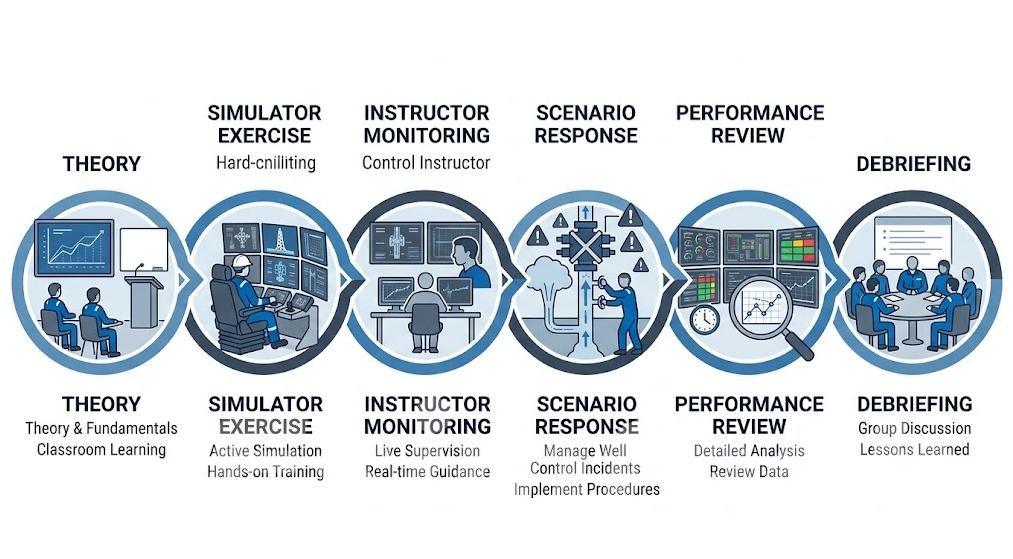
IADC WellSharp uses competency-based assessments that mix theoretical knowledge with practical application. Depending on the certification level, candidates may go through written examinations, simulator-driven assessments, and scenario evaluations. The program also places a lot of weight on actually applying well control principles during realistic drilling moments.
IWCF certification also includes written exams and hands-on evaluations, sometimes called practical assessments. For higher-level credentials candidates may have to prove that they can manage well control scenarios using drilling simulators. IWCF evaluations are made to check technical understanding, together with decision-making abilities when everything feels time-pressured.
Even if both systems rely on examinations and practical reviews, the way they structure the assessment, and the scoring approach, can differ. That usually depends on the training center involved, and also on the specific certification tier.

4. Simulator Training Requirements
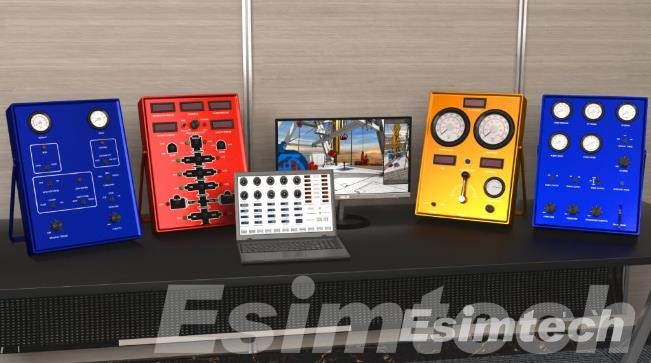
Modern well control training increasingly relies on drilling simulators to provide realistic practice environments. Both IADC and IWCF recognize the importance of simulation-based training, especially for advanced certification levels.
| Comparison Aspect | IADC WellSharp Simulator Training Requirements | IWCF Well Control Simulator Training Requirements |
| Training Objective | Focuses on developing practical well control skills and improving personnel competency in real drilling situations | Focuses on evaluating well control knowledge, decision-making ability, and response skills under simulated conditions |
| Main Training Focus | Emphasizes operational procedures, equipment handling, and effective response during drilling well control events | Emphasizes standardized assessment of well control scenarios across drilling, completion, and intervention operations |
| Simulator Use Requirement | Simulator training is required for higher-level certifications, especially driller and supervisor levels | Simulator assessments are required for advanced certification levels, particularly Level 3 and Level 4 programs |
| Simulation Scenarios | Includes kick detection, shut-in procedures, well pressure control, circulation methods, and blowout prevention operations | Includes well kicks, abnormal pressure events, equipment failures, emergency response, and complex well control situations |
| Assessment Purpose | Evaluates whether candidates can correctly apply well control procedures during realistic operational challenges | Evaluates whether candidates can analyze situations, make decisions, and manage well control incidents effectively |
| Simulator Environment | Often uses drilling simulators designed to represent rig operations and common drilling workflows | Uses approved well control simulators that meet IWCF assessment standards and competency requirements |
| Candidate Performance Evaluation | Assesses operational skills, response accuracy, and ability to follow well control procedures | Assesses technical knowledge, situational awareness, communication, and decision-making skills |
| Practical Skills Tested | Well shut-in methods, pressure monitoring, kick handling, BOP operation, and drilling parameter control | Well control diagnosis, pressure management, emergency response planning, and advanced incident management |
| Scenario Complexity | Complexity increases according to certification level and job responsibility | Higher levels involve more complex and challenging scenarios requiring supervisory decision-making |
| Role-Based Training | Simulator requirements are closely linked with specific drilling positions, such as driller and supervisor | Simulator assessments are linked with certification pathways for drilling, completions, and well intervention roles |
| Instructor Role | Instructors guide candidates through practical exercises and evaluate operational competency | Instructors supervise standardized simulator assessments and ensure compliance with IWCF requirements |
| Evaluation Criteria | Focuses on correct procedures, operational control, and safe handling of drilling situations | Focuses on competency demonstration, decision quality, and effective management of well control events |
| Certification Outcome | Confirms that personnel can perform assigned well control duties safely in drilling operations | Confirms that personnel meet internationally recognized well control competency standards |
| Typical Users | Drillers, assistant drillers, toolpushers, and drilling supervisors | Drilling supervisors, engineers, operators, well intervention personnel, and senior well control specialists |
5. Industry Recognition and Acceptance
Both IADC and IWCF certificates are widely recognized internationally and taken by many operators in oil and gas industry. Still, what gets accepted can shift by company, region, and the needs of the project at hand.
IADC WellSharp is especially common among drilling contractors and firms working in areas where IADC standards get preferred. Many drilling contractors ask for IADC certification as part of their personnel qualification framework.
IWCF certification has strong global recognition and it is used widely by operators and contractors across different regions. Some companies even ask for IWCF certification specifically, especially for offshore drilling, well intervention, or completion activities.
In practice, neither certificate is universally better. The certification that gets preferred usually depends on what the employer asks for, contract terms, and how local regulators expect things to be handled.

6. Certification Validity and Renewal
Both IADC and IWCF certificates call for periodic renewal so personnel can keep current knowledge and operational skills.
IADC WellSharp certificates typically have a set validity window, after which the personnel need to complete renewal training, plus reassessment. Those renewal requirements are meant to make sure workers stay familiar with modern well control practices, new technologies, and current industry standards.
IWCF certificates also have an expiration interval and they call for recertification. Personnel must complete the approved training, and successfully clear the assessments in order to keep their certification status in good standing.
Regular renewal is especially important too, because drilling technologies, equipment blueprints, and safety workflows continue to evolve over time.
Summary Comparison Chart
| Comparison Aspect | IADC WellSharp Certificate | IWCF Well Control Certificate |
| Organization Type | Industry association representing drilling contractors and oilfield companies | Independent nonprofit organization focused on well control competency |
| Main Purpose | Provides competency-based well control training for drilling personnel | Establishes global standards for well control training and assessment |
| Primary Focus | Practical well control skills and operational performance | Standardized evaluation of well control knowledge and decision-making ability |
| Main Application Areas | Mainly drilling operations, including land rigs and offshore drilling | Drilling, completions, well intervention, and related well control activities |
| Target Personnel | Drillers, assistant drillers, toolpushers, drilling supervisors, and rig personnel | Drilling personnel, supervisors, engineers, well intervention specialists, and managers |
| Training Approach | Competency-based training with emphasis on operational scenarios | Structured training with theoretical learning and practical competency assessment |
| Certification Levels | Includes introductory, driller, supervisor, and incident management levels | Includes multiple levels such as Level 2, Level 3, and Level 4 for different responsibilities |
| Assessment Methods | Written exams, practical exercises, and simulator-based evaluations | Written examinations, practical assessments, and simulator testing |
| Simulator Training | Uses well control simulators to evaluate response to drilling scenarios | Uses advanced simulators to test handling of complex well control events |
| Industry Recognition | Widely recognized by drilling contractors and many operators worldwide | Globally recognized by operators, contractors, and training organizations |
| Certification Validity | Requires periodic renewal through approved training and assessment | Requires periodic recertification to maintain competency |
| Training Provider Requirements | Training must be delivered through approved IADC-accredited centers | Training must be conducted through IWCF-approved training centers |
| Strengths | Strong focus on real-world drilling operations and contractor requirements | Strong international recognition and standardized competency evaluation |
| Common Users | Drilling contractors, rig crews, and operational drilling teams | International drilling teams, operators, completion teams, and well intervention professionals |
| Best Suited For | Personnel focused on drilling operations and rig-based careers | Professionals seeking broad international well control certification across multiple disciplines |
How to Choose Between IADC and IWCF Certificates
Choosing between IADC and IWCF certification really depends on what the job asks for, plus what the employer expects, and honestly, the project scope. Drilling personnel should first verify what their company wants, or what the project operator is insisting on, because otherwise you might end up with a mismatched credential.
If you work mostly with drilling contractors, IADC WellSharp can feel like the better fit. It has a direct tie to drilling operations, so the training lines up well with what you do in the field. On the other hand, if your role is leaning toward international assignments, offshore operations, completions, or well intervention tasks, IWCF certification may be the one that travels better across regions and stakeholders.
Sometimes, seasoned oilfield professionals decide to collect both. The reason is usually simple, better career pathways, and a more rounded understanding of worldwide well control standards that are used across different systems.
Final Thoughts
IADC and IWCF certificates, represent two of the most respected well control certification systems within the oil and gas industry. While both try to push higher safety standards and better competency, they do differ in organizational background, training structures, assessment methods, and where people actually use them. The best choice often comes down to what you personally want career-wise, what your employer expects, and the specific operational environment you will be working in.
For drilling engineers, rig personnel, and well intervention specialists, getting a recognized well control certification is a worthwhile investment. It strengthens your professional capability and helps support safer oil and gas operations.