Coiled Tubing vs. Snubbing Operations: Training the Next-Gen Intervention Specialists

Written By: Computer Science Professor
Deeply rooted in the R&D of simulators for the oil and gas industry, committed to bringing safety to every oil worker.
Global oil and gas development is rapidly advancing towards the era of high-temperature, high-pressure (HPHT), deepwater, and ultra-long horizontal wells, resulting in a sharp increase in the demand for complex pressure-bearing operations. In such a high-risk environment, achieving wellbore integrity restoration without well shut-in requires even higher technical capabilities from the operations team.
For a long time, the oilfield services industry has regarded various downhole operations as isolated units, and technicians have often been confined to a single process. However, in the face of today’s extreme well control challenges, the traditional well repair experience has exposed obvious skill deficiencies. To ensure the safety of high-value assets, the new generation of technical experts must thoroughly understand the mechanical principles of coiled tubing and professional snubbing and possess cross-domain comprehensive response capabilities.
The Technical Showdown — Coiled Tubing vs. Snubbing Operations
When designing the underground operation plan or creating the personnel capability matrix, it is crucial to clearly understand the mechanical performance differences between the coiled tubing and the snubbing operations without well shut-in. Although both systems are used for pressure-bearing operations, their structural characteristics determine different application boundaries.
Wellhead pressure limit and mechanical boundary
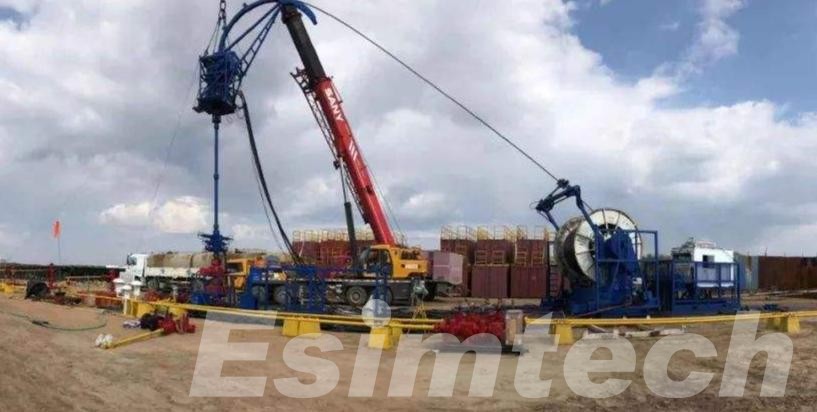
- Coiled Tubing: A continuous flexible steel pipe wound on a reel. Although it is highly efficient in operation, when dealing with extremely high ground injection pressures (especially exceeding 8,000 to 10,000 psi), the pipe body is prone to expansion, fatigue and structural buckling.
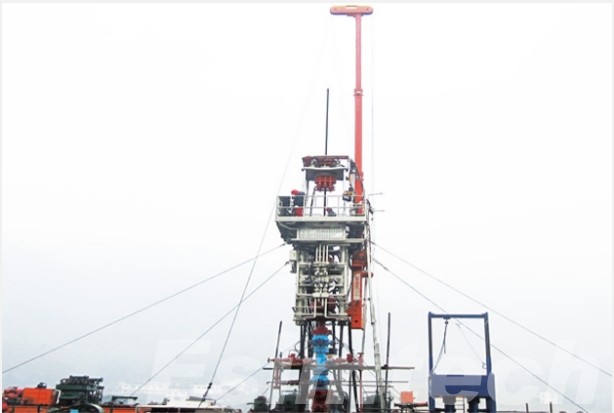
- Unconventional Snubbing: The preferred method for extreme high-pressure environments. Through a highly resilient non-continuous pipe string and heavy-duty hydraulic jacks, this device can forcibly lower the pipe string into the high-pressure wellbore. Even if the upward force at the wellhead far exceeds the weight of the pipe string itself, the operation can still be stable.
Torque and Mechanical Load Capacity
As a continuous flexible pipe string, the coiled tubing cannot be rotated as a whole from the surface, which significantly limits its performance in heavy-duty mechanical milling, intense scale removal, and complex downhole retrieval operations.
On the contrary, the Snubbing (pressurized operation) tubing string uses rigidly connected drill pipes or oil pipes. This enables the equipment to safely apply high torque and achieve pressurized rotation, making it the preferred solution for clearing stubborn wellbore obstructions and retrieving complex downhole snagged objects.
Horizontal extension limit and frictional resistance
In long displacement horizontal wells, the coiled tubing is highly prone to spiral buckling. When the flexible pipe is pushed into the deep part of the horizontal section, it will lock against the casing wall due to helical buckling, resulting in extremely high friction resistance that causes “stuck”, preventing further advancement.
The Snubbing pipe column has extremely high structural rigidity, which can effectively resist helical deformation. Combined with the powerful thrust of the hydraulic jack, it can easily overcome severe lateral friction resistance, significantly enhancing its extension capability in large-offset wells and high-angle wellbores.
Hidden Costs and Fatal Risks of Live-Equipment Training
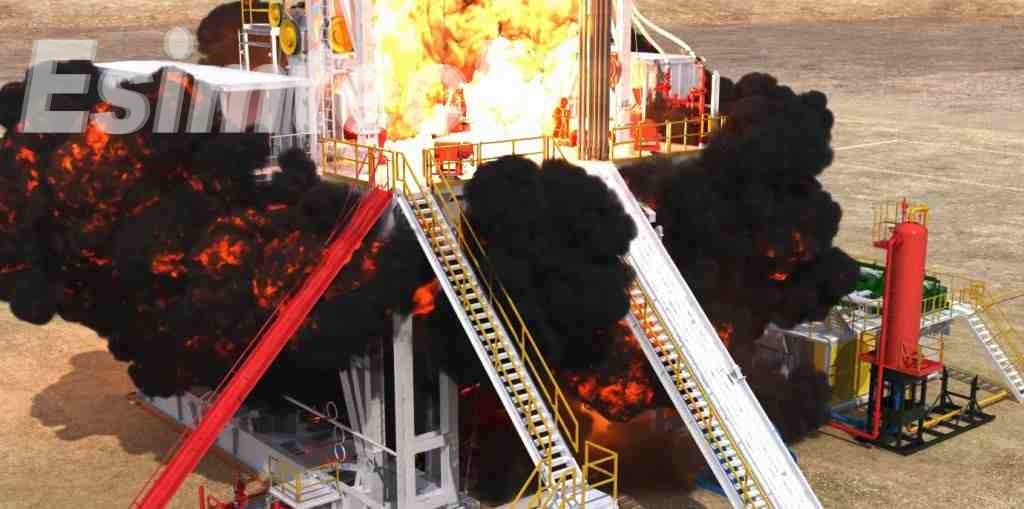
The pressure well control operation technology is highly effective in extreme environments. However, personnel safety training has always been a challenge for oil service companies. Training newbies using actual well site equipment is extremely costly, and the safety risks are uncontrollable.
Take the operation of continuous tubing as an example. Even a minor operational error can cause irreversible damage to the actual equipment. For instance, if the pressure of the clamping block of the injection head is improperly set, it may crush the pipe wall. If the speed at which the drill pipe is raised and lowered is unreasonable, it will accelerate fatigue in the pipe material. Once these errors lead to a breakage of the drill pipe in the well, it will directly result in an emergency well control accident, causing millions of dollars in production losses.
During the well control operation, the risks are even more uncontrollable. This operation requires manual and precise synchronization of various equipment on the ground under high-pressure conditions. The most crucial and dangerous part of the entire operation lies in finding the pressure equilibrium point quickly and accurately.
The physical core of the equilibrium point:
- Lightly pressurized zone: The thrust force in the well is greater than the total self-weight of the pipe string. There is a tendency at the wellhead to push the pipe string out. Operators must apply downward pressure to “push” the pipe string into the well.
- Weight-on-Rods Zone: As the pipe string continues to be lowered, the total weight exceeds the wellhead thrust. The pipe string begins to sink under its own weight, and the operation switches to anchoring and suspension.
The critical instant when the two forces converge is the point of equilibrium. If the trainee misjudges the equilibrium point or mistakenly moves the traveling gate and the fixed gate handle, the well pressure will immediately take over the wellbore. In a fraction of a second, thousands of meters of steel pipe will be ejected like a rocket, flattening the drilling platform and causing a catastrophic blowout. Here, the failure rate of simulated real combat is always zero.
The Synergy of Esimtech Simulators — Empowering the Next-Gen Crew
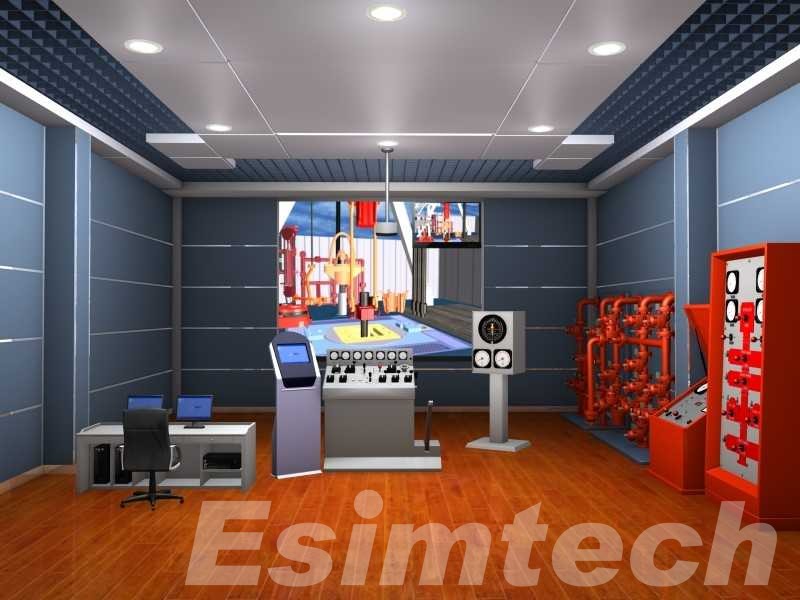
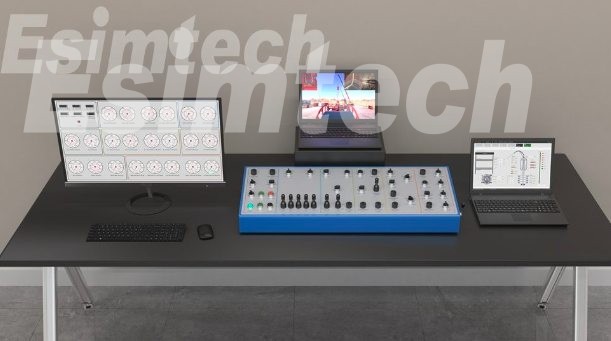
To avoid on-site high-risk situations and cultivate top operators, major drilling contractors and international training institutions are widely adopting digital technologies. The full-scale blowout prevention simulator of Esimtech enables trainees to gain equivalent practical experience in an environment free from the risks associated with pressurized operations.
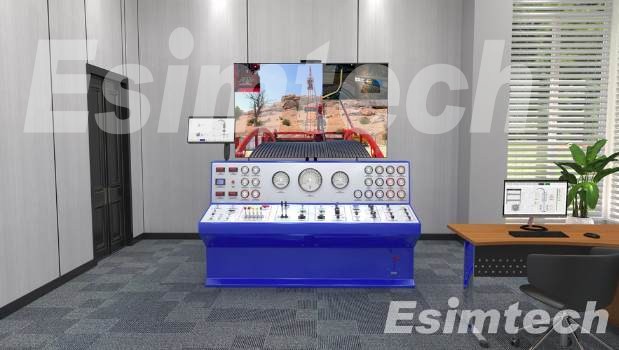
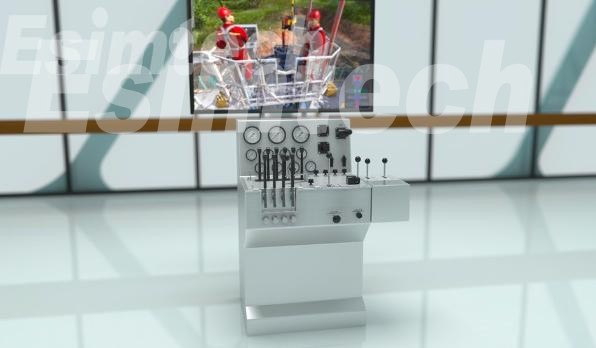
1:1 Physical Console
This system is not a simple software simulation; instead, it is equipped with an actual control console that fully replicates the layout of a real blowout prevention drilling platform. Through heavy-duty hydraulic control levers, fully functional BOP (Blowout Preventer) control panels, and the driller’s panel, it forces the trained personnel to establish a true muscle memory.
High-fidelity physical engine
The underlying mathematical engine can perform real-time calculations for underground mechanics. The system not only accurately simulates the buckling of the pipe string, wellbore resistance, and the friction during raising and lowering the drill string, but also simulates the instantaneous load shock caused by the action of the gate valve at the critical balance point. Through this, trainees can learn to identify the subtle fluctuations in the hydraulic gauge and master the precise pressure control feel required for blowout prevention and well control operations.
Emergency Sandbox
The instructor can simply perform a single operation to introduce sudden real-life emergencies during the training. The trainees will encounter real challenges such as the aging of the blowout preventer rubber core, sudden well blowout, or the disengagement of the ram. This enables the operators to repeatedly practice the emergency well control procedures in a safe sandbox environment until they develop muscle memory.
By integrating the Esimtech well control simulator with the coiled tubing simulator, the training center can leverage the combined effect of being one plus one greater than two. The institution no longer needs to teach individual skills in isolation; instead, it can offer integrated downhole operation courses. This dual simulator architecture helps the college conduct advanced practical training, facilitating engineers and supervisors to successfully pass the IADC WellSharp and IWCF Level 3 and 4 certifications, thereby making it more attractive to win high-value enterprise orders.
To Summary
In the face of more challenging underground environments and stricter safety regulations, the traditional on-the-job training for high-pressure oil well intervention has become unsustainable. While coiled tubing and pressure-controlled operations (snubbing) are crucial for increasing production, their safety and efficiency are highly dependent on the skills of the operators.
Introducing the Esimtech high-fidelity simulation system can transform high-risk on-site exploration into predictable and quantifiable skill improvement. Equipped with a full-scale simulator, it not only directly protects personnel and equipment safety but also helps your enterprise establish a new generation of industry benchmarks in oil well intervention.