Deepwater Challenge: Understanding the Key Differences Between Drillships and Semi-Submersible Rigs

Written By: Computer Science Professor
Deeply rooted in the R&D of simulators for the oil and gas industry, committed to bringing safety to every oil worker.
Offshore exploration is one of the most technically demanding fields in the global energy chain. As oil and gas development continues to move towards ultra-deep waters, choosing between a drilling ship and an offshore drilling platform (such as a semi-submersible or jack-up platform) is a core capital expenditure (CAPEX) decision that directly determines the safety of the project, operational efficiency, and overall return on investment (ROI).
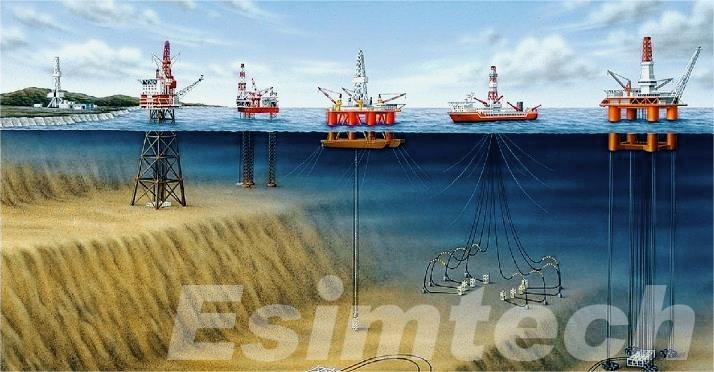
Although in the broad industry terminology, “rig” encompasses all types of offshore drilling structures such as jack-up platforms, semi-submersible platforms, and drilling ships. However, in actual operations and logistics procurement, operators usually compare the highly mobile drilling ships with the relatively fixed offshore drilling platforms in two directions. For modern energy enterprises, thoroughly assessing the core differences in dynamic positioning (DP), environmental adaptability, and operational training requirements among them is the key to ensuring the success of the projects.
Executive Matrix: Drillship vs. Offshore Rigs at a Glance
To provide clear direction for project evaluation, the structural, operational, and environmental differences are synthesized below:
| Operational Metric | Drillship | Semi-Submersible Rig | Jack-Up Rig |
| Water Depth Capacity | Ultra-deepwater (Up to 12,000+ ft / 3,600+ m) | Deep to Ultra-deepwater (Up to 10,000 ft / 3,000 m) | Shallow Water (Up to 500 ft / 150 m) |
| Mobility & Transit Speed | High (Self-propelled, 12–14 knots) | Low to Medium (Requires towing or slow self-propulsion) | Very Low (Must be towed via heavy-lift vessels) |
| Station-Keeping System | Dynamic Positioning (Typically DP3) | Mooring Arrays / Spud Lines or DP Systems | Bottom-founded (Solid structural legs) |
| Variable Deck Load (VDL) | Extremely High (Massive onboard fluid & tubular storage) | Medium (Highly sensitive to weight changes) | Limited (Relies heavily on frequent supply runs) |
| Optimal Marine Environment | Remote exploratory blocks; calm to moderate wave cycles | Harsh environments with severe wave motion (e.g., North Sea) | Near-shore environments with stable seabed topography |
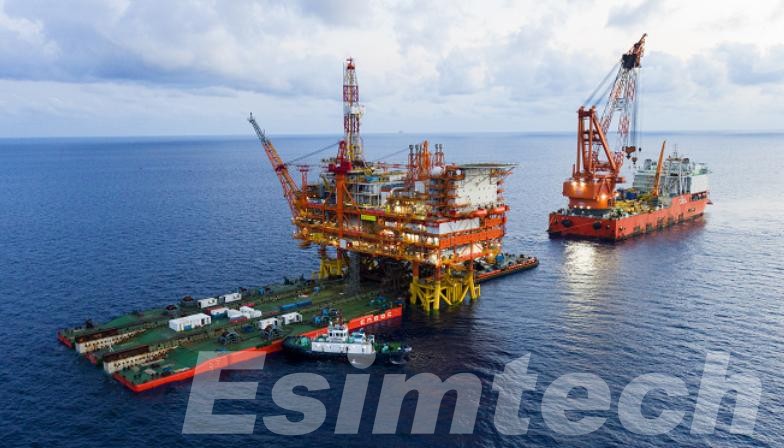
Deep-Dive Core Contrasts: Mobility, Stability, and Storage
A. Mobility and Exploration Efficiency
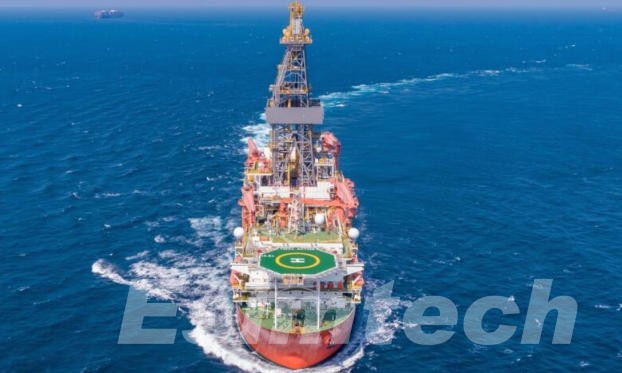
The drilling ship adopts a standard hull design and is a completely independent ocean-going vessel. With an integrated ship propulsion system, it can undertake transoceanic deployment without the assistance of a tugboat. This self-navigation capability significantly shortens the mobilization cycle, thereby greatly reducing the transfer costs between distant exploration blocks.
In contrast, traditional offshore drilling platforms such as semi-submersible and jack-up platforms are essentially structures rather than standard ships. Jack-up platforms cannot do without complex wet towing operations or dry transportation by heavy-lift vessels; semi-submersible platforms, although having some self-navigation capabilities, are limited by their hydrodynamic performance, resulting in lower speeds, longer transportation cycles, and higher allocation costs.
B. Hydrodynamic Stability and Water Surface Positioning
Compared with drilling ships, the core advantage of semi-submersible platforms lies in their outstanding stability under harsh sea conditions. Semi-submersible platforms operate by submerging underwater using ballast pontoons. Due to their extremely small cross-sectional area in the wave-height variation zone (near the waterline), they are minimally affected by wave loads, making them an ideal choice for operations in extreme sea areas such as the North Sea.
In contrast, drilling ships adopt traditional hull designs, resulting in a larger frontal area exposed to wind, waves, and currents. To precisely locate the wellhead during deep-water operations, drilling ships must rely entirely on advanced dynamic positioning systems (DP3), using full-turn thrusters to continuously counteract environmental loads. Although this system is highly efficient, it consumes a large amount of energy and has potential technical risks such as thruster failure.
C. Fluid and Equipment Storage Capacity
The drilling ship has significant advantages in terms of variable deck load (VDL) and hull capacity. The large internal space of the hull can accommodate a large amount of drilling mud, cement, pipes and fuel. This powerful self-sufficiency capability makes it highly suitable for operations in remote sea areas where the supply chain is unstable and difficult.
In contrast, the space constraints for semi-submersible and other offshore drilling platforms are even more stringent. Semi-submersible platforms must precisely balance the weight distribution to maintain stability and prevent tilting, and thus are highly dependent on frequent shore-based material supplies.
The Ultra-Deepwater Risk Profile: Operational Challenges
Operating such complex assets worth millions of dollars, offshore workers face severe technical risks. For drilling vessels equipped with the Dynamic Positioning (DP) system, the main threat lies in the “drift-off” or “drift-off” caused by the failure of the DP system. Once the drilling vessel deviates from its position when connecting the underwater riser, it is highly likely to cause the rupture of the underwater wellhead, leading to a catastrophic blowout and extremely difficult well control challenges.
For semi-submersible and jack-up platforms, whether it is maintaining stability in harsh sea conditions or dealing with high-pressure gas surges, there can be no room for any operational delays or mistakes. In such high-risk processes, any calculation error could rapidly deteriorate and even escalate into an international environmental disaster.
Industry consensus indicates that professional technical capabilities and real-time situational awareness are the keys to preventing catastrophic asset losses in deepwater operations. In the face of modern high-pressure, high-temperature (HPHT) environments, mere theoretical training is no longer sufficient.
Mitigating Risks Through Advanced Simulation Technologies
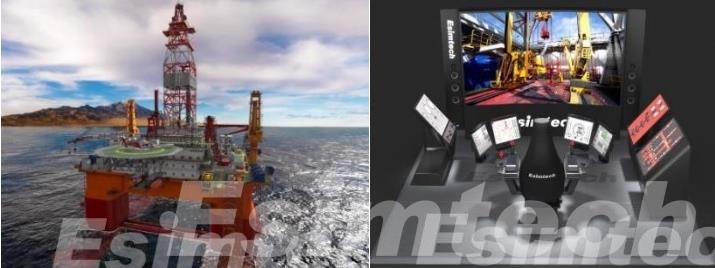
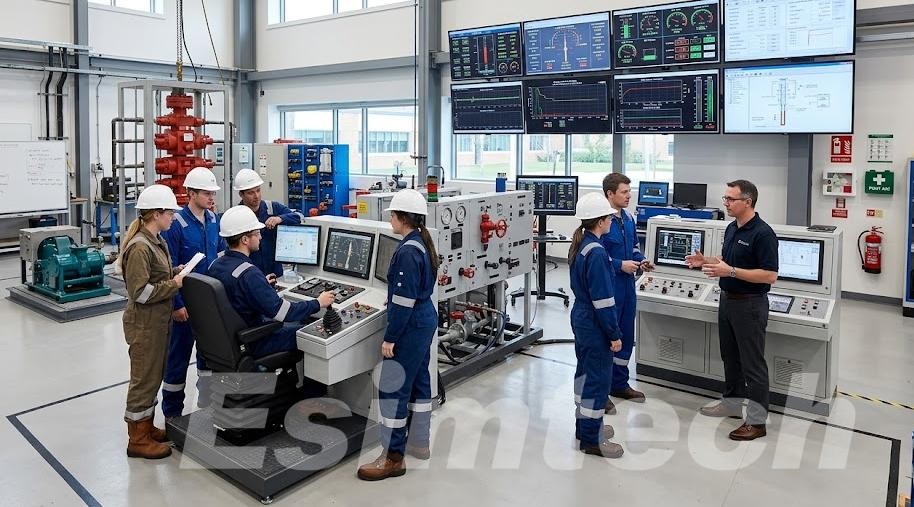
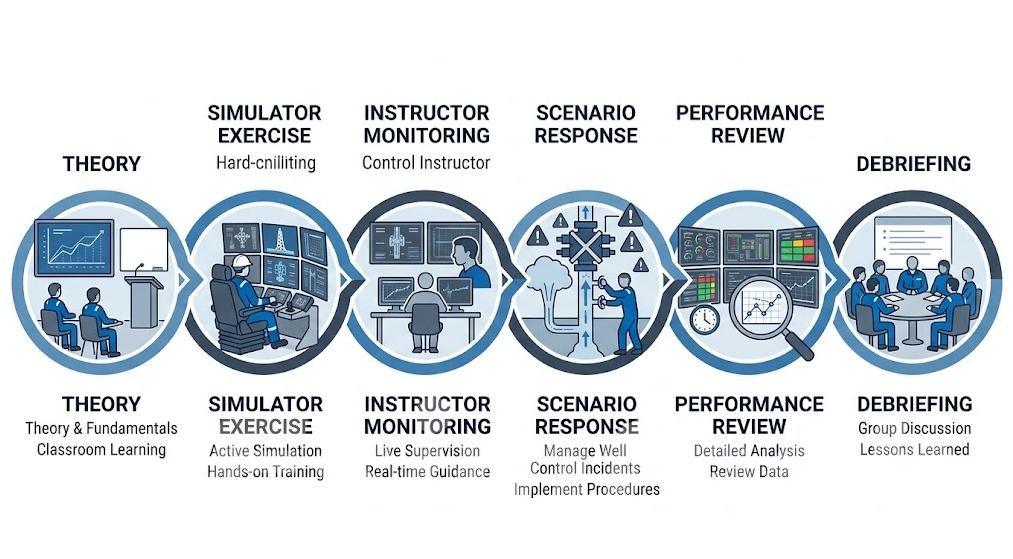
To minimize operational errors in offshore drilling, global operators are widely deploying high-fidelity simulation systems. Such training must closely align with the specific operational characteristics of drilling vessels and floating/fixed platforms:
- For drilling ship operations: The training needs to seamlessly integrate traditional navigation skills with complex downhole engineering. By using an integrated drilling and well control simulator and equipping it with advanced driller control chairs (Cyberchairs) hardware, operators can practice and master emergency procedures such as real-time well blowout detection, controlled pressure drilling (MPD), and emergency disconnection of the standpipe (EDP) under simulated power positioning (DP) failures.
- For offshore drilling platforms (semi-submersible/self-elevating): The simulation system focuses on replicating downhole friction, stuck pipe mechanics, and the automated manifold handling mechanism. Through a virtual reality (VR) training simulator, the deck crew and operators can conduct in-depth rehearsals of key downhole conditions, well control procedures, and the well control matrix before going on stage.
By precisely simulating hydraulic models, sea conditions and equipment responses, modern simulation ecology has successfully bridged the gap between classroom theory and on-site practical operation, ensuring that frontline personnel can make correct decisions instantly when facing unexpected situations.