Oil Rig Fire Emergency Response: Training, Evacuation, and Simulation

Written By: Computer Science Professor
Deeply rooted in the R&D of simulators for the oil and gas industry, committed to bringing safety to every oil worker.
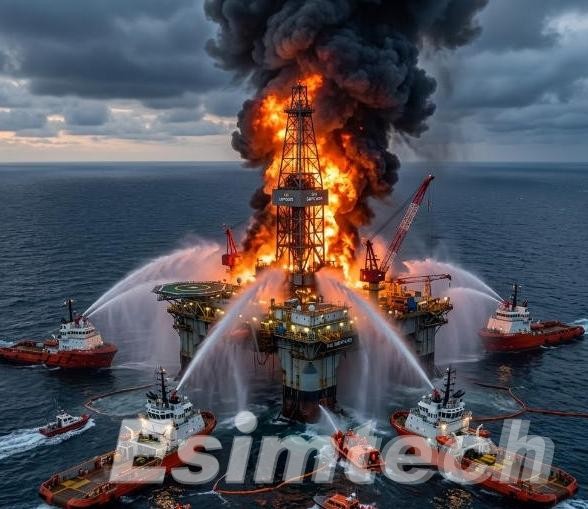
A fire on an oil drilling platform can escalate rapidly within seconds. Flames, smoke, toxic gases, equipment failures, and high-pressure systems can all turn an initially manageable incident into a life-threatening emergency.
For oil and gas companies, effective emergency preparedness is not just about creating a paper-based emergency plan. Relevant personnel must possess skills such as identifying hazards, making decisions under pressure, communicating with the team, and safely evacuating.
For this reason, modern emergency response training for oil drilling platform fires is increasingly combining traditional drills with realistic simulation training.
Why Oil Rig Fire Emergencies Require Specialized Training
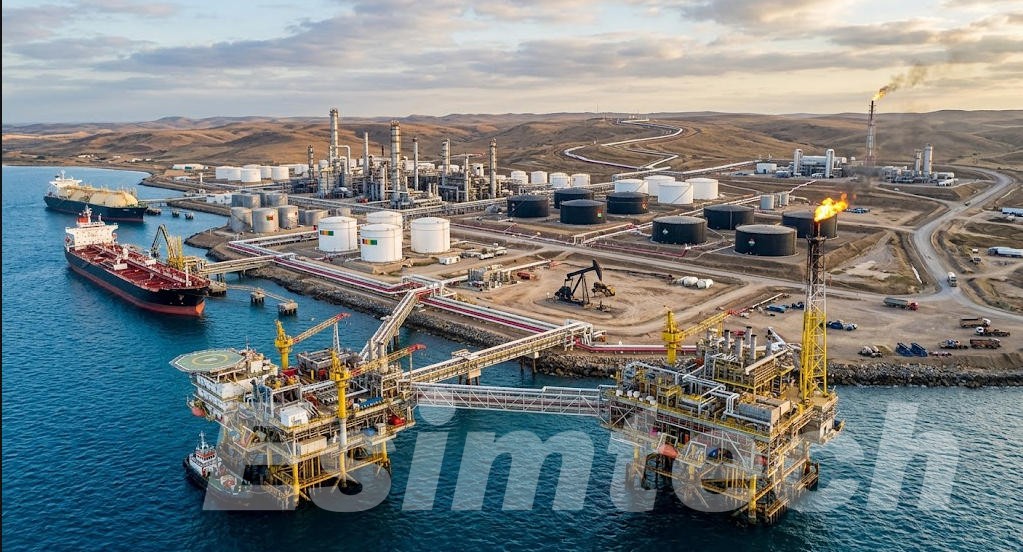
Oil drilling platforms have unique risks of fire and explosion. Flammable hydrocarbons, high-pressure equipment, electrical systems, and enclosed working spaces make emergency response extremely challenging.
Compared to onshore facilities, the evacuation routes for personnel on offshore facilities are also more limited. While dealing with smoke, alarms, changing dangers, and communication obstacles, personnel may need to quickly head to designated assembly points, lifeboats, or other emergency evacuation facilities.
The biggest challenge is not just knowing what to do.
But whether one can take prompt and correct actions under pressure.
Therefore, effective emergency training for oil drilling platforms should not be limited to classroom teaching. Personnel need to have the opportunity to repeatedly practice emergency procedures and develop the decision-making skills needed in real emergencies.
Oil Rig Fire Emergency Response: What Should Workers Do?
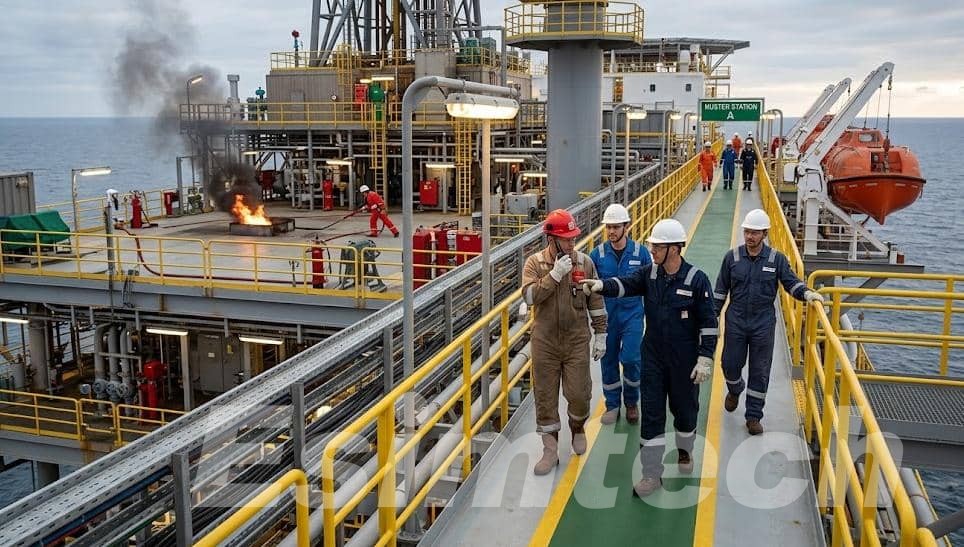
Although each facility has its own emergency response plan and procedures, effective response to fires on oil drilling platforms typically involves several key stages.
1. Detect the Emergency and Raise the Alarm
The first priority is to identify signs of fire, smoke, abnormal equipment conditions, or related hazards, and immediately follow the on-site alarm and notification procedures.
Quick communication can secure valuable time for the emergency response team to assess the situation and initiate corresponding response measures.
2. Assessing the Situation
Personnel need to understand the nature and specific location of the emergency.
Key questions may include:
- Where is the fire located?
- Is there a risk of gas leakage?
- Which areas or escape routes may be affected?
- Has the accident spread?
- Is immediate evacuation necessary?
Training should help personnel make these judgments in the face of emergencies without being overwhelmed by panic, and not being at a loss for what to do.
2. Isolate and Control the Hazard
Based on their training and established procedures, trained personnel may need to assist in equipment shutdown, hazard source isolation, activation of the fire system, or other emergency operations.
The goal is to protect the safety of personnel while preventing the situation from worsening.
4. Evacuating and Counting Personnel
When evacuation is necessary, workers should follow the designated escape routes to the corresponding assembly point or evacuation location.
Personnel count is also crucial. The emergency team needs to know which personnel have reached safe locations and whether anyone is still trapped in dangerous areas.
Oil Rig Fire Evacuation: Why Drills Matter
Only when personnel can execute emergency procedures at critical moments will these procedures truly be effective.
Although traditional fire drills are an important part of safety training on oil drilling platforms, they also have limitations. After all, it is impossible to merely simulate real fire, explosion, blowout or toxic gas leakage accidents safely just for the purpose of training.
However, training based on simulation technology can provide additional value.
Traditional drills allow personnel to understand the actions to be taken, while realistic simulators can help them practice how to react.
Training based on simulation technology has the following advantages:
- Repetitive emergency scenarios
- Realistic operating environment
- Safety drills for high-risk situations
- Individual and team practice
- Performance evaluation and feedback
- Opportunities to repeatedly practice scenarios and correct errors
The training team does not need to wait for the annual drill to simulate various different emergencies and allow personnel to repeatedly practice response measures.
How Oil Rig Fire Simulation Improves Emergency Response
1. Realistic Emergency Scenarios
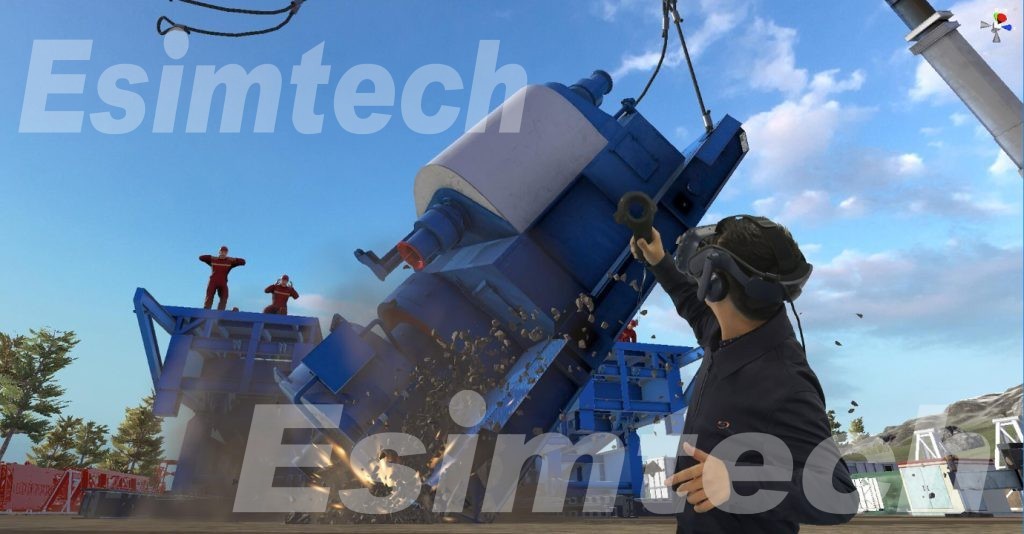
The simulator can reproduce various emergency situations in a controlled training environment.
According to the training objectives, the scenarios may include oil drilling platform fires, blowouts, explosions, hydrogen sulfide (H₂S) leaks, equipment failures, and emergency evacuations.
This enables trainees to experience situations that cannot be recreated in the real world due to being too dangerous or unrealistic.
2. Practice Without Real-World Risk
One of the greatest advantages of simulation training is that it allows personnel to practice for high-risk events without exposing them to real fires, explosions, or toxic gas hazards.
Trainees can make mistakes, review their decisions, and repeat the scenarios without incurring serious consequences in real emergency situations.
3. Develop Decision-Making Under Pressure
Emergency response is not just about memorizing operating procedures.
Personnel must be able to identify changing situations, select appropriate actions, communicate information, and respond quickly.
Simulation training helps convert theoretical knowledge into actual emergency response skills.
4. Improve Team Coordination
Emergency situations on oil drilling platforms rarely involve just one individual.
The driller, control room operators, HSE (Health, Safety, and Environment) personnel, emergency response teams, and other platform staff may each have different responsibilities.
Team-based simulation exercises help personnel practice communication, collaboration, task allocation, and emergency decision-making in a common scenario.
5. Measure Training Performance
Effective training is not just about “whether trainees have completed the drills”.
It should also clearly address the following points:
- Did trainees correctly identify the emergency situation?
- Did they choose the appropriate response measures?
- Did they follow the evacuation procedures?
- How fast was their response?
- At which points did they make mistakes?
Through performance evaluation, instructors can identify weak points and formulate targeted follow-up training plans.
A Practical Oil Rig Fire Emergency Training Workflow
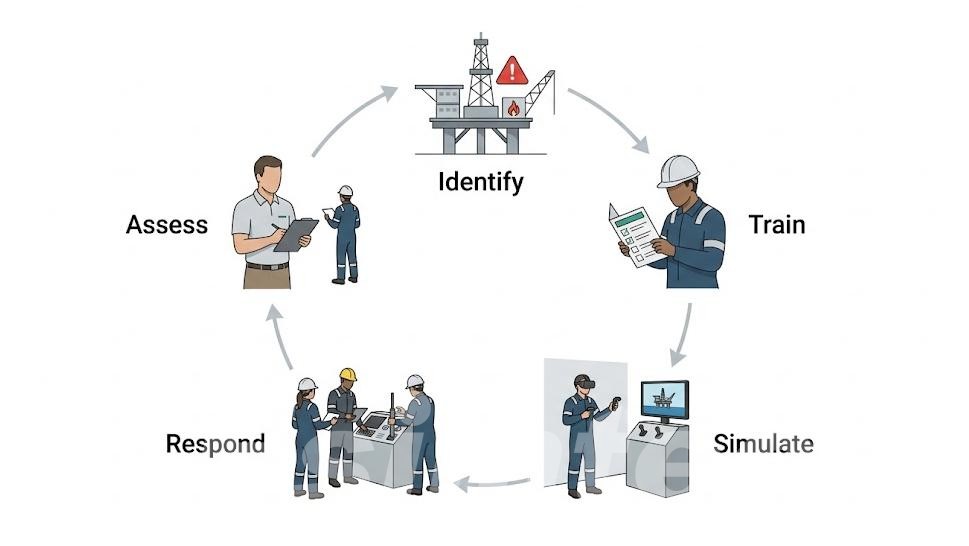
A structured simulation training program can consist of the following five simple steps:
Step 1 – Hazard Identification
Identify potential hazards related to fires, explosions, gas leaks, and evacuation.
Step 2 – Emergency Procedure Training
Introduce alarm systems, communication procedures, shutdown processes, emergency response duty division, and evacuation routes.
Step 3 – Simulation Drill
Place the trainees in a realistic virtual oil drilling platform environment and set up emergency scenarios.
Step 4 – Team Emergency Drill
Have the personnel work together to practice their respective duties.
Step 5 – Evaluation and Repeat Training
Evaluate performance, point out errors, and repeat the drill until the personnel become more proficient and consistent in their mastery of the emergency response procedures.
This is not intended to replace emergency response plans or on-site drills; rather, it provides an additional practical training for personnel before they face real emergencies.
Using Simulation to Build Oil Rig Emergency Readiness
For oil and gas companies, the goal of emergency training is not just to complete a single drill.
The core objective is to help personnel develop the necessary skills and confidence so that they can respond correctly in the event of a real emergency.
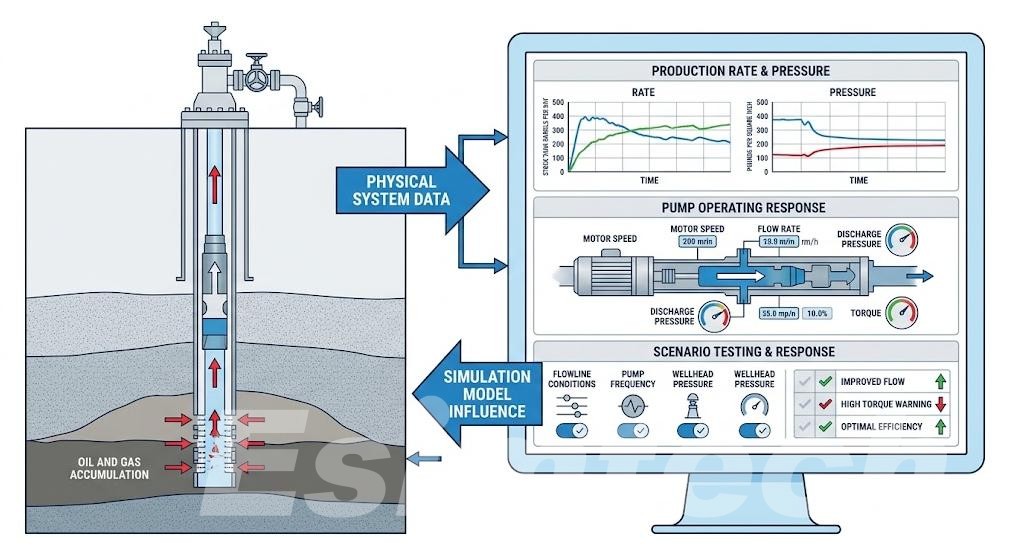
Esimtech is dedicated to developing various simulation solutions for the oil and gas industry, including drilling simulators, well control simulators, VR emergency training systems, and customized simulation solutions.
The company’s emergency training solutions can simulate real scenarios such as fires, blowouts, explosions, hydrogen sulfide (H₂S) leaks, and emergency evacuations, and support individual and team training as well as performance evaluation.
By using a realistic simulation environment, enterprises can train personnel to identify hazards, make decisions under pressure, collaborate as a team, and execute emergency evacuation procedures without the risk of re-enacting a real drilling platform fire.
Looking for an oil rig fire emergency training simulator or a customized oil and gas emergency response training solution? Contact Esimtech to discuss your training requirements.