Navigation Simulators Reducing Maritime Incident Risks Through High Fidelity Bridge Maneuvering

Written By: Computer Science Professor
Deeply rooted in the R&D of simulators for the oil and gas industry, committed to bringing safety to every oil worker.
In today’s maritime business, the price of a single navigation error can run into millions of dollars in damages. With increased congestion in international shipping routes, conventional training methods are no longer considered adequate. Navigation simulators can offer a safe environment to practice complex vessel maneuvers. Let’s take a deep look at it.
The Critical Link Between Simulation and Maritime Safety
In contemporary maritime practice, there is a reduced margin of error. This is especially true with the advent of larger vessel sizes, as exemplified by Ultra Large Container Vessels (ULCVs) and LNG carriers. The physical limitations of ports and waterways have become more critical. Statistical studies of maritime casualty data have invariably revealed that human error contributes to between 75% and 96% of maritime casualties, largely as a result of a lack of situational awareness or proper training for rare emergencies.
For port authorities and ship management companies, navigation simulators are the first line of defense against operational failure. This is no longer just a question of familiarization; it is a question of mitigating risk. With the use of simulation, organizations can test their bridge crews in a safe environment to guarantee that the first time a pilot encounters a steering failure in a busy channel, it is not in a real vessel.
Enhancing Situational Awareness in Complex Harbor Maneuvering
The transformation from open-sea navigation to harbor navigation is the riskiest phase in any given voyage. The complex nature of the harbor demands that pilots and masters process a massive amount of variables at once. These variables include tidal currents, wind shears, forces exerted by tugboats, and the proximity of other vessels.
High-fidelity simulators mimic these variables with precision. To ensure that a simulator is effective in reducing risk, it must:
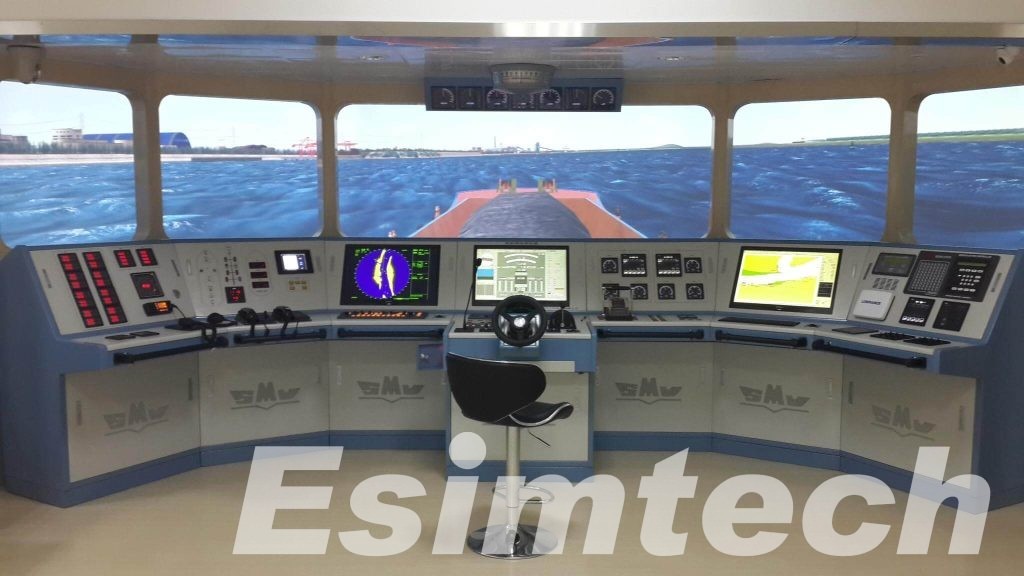
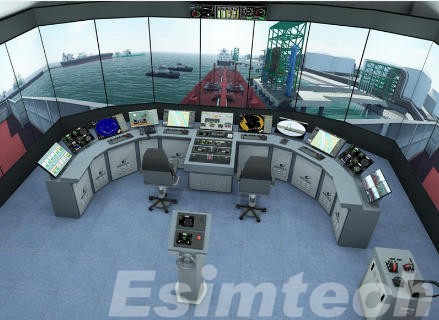
- Accurate Visual Perspectives: A 240-degree to 360-degree field of view that enables realistic “out-of-the-window” navigation and accurate determination of distance to piers and buoys.
- Sensor Integration: Real-time integration with the visual environment and ship’s hardware, including Radar/ARPA, ECDIS, and AIS. Lag between helm control and visual refresh defeats the user’s immersion and results in “simulator sickness” or, worse, incorrect muscle memory.
- Environmental Stressors: The capacity to immediately create localized fog, squalls, or extreme glare at night. Training in these environments will help build the “mental models” required for bridge teams to respond with calm, decisive action during actual reduced visibility.
Technical Core: Real-Time Hydrodynamic Modeling for Incident Prevention
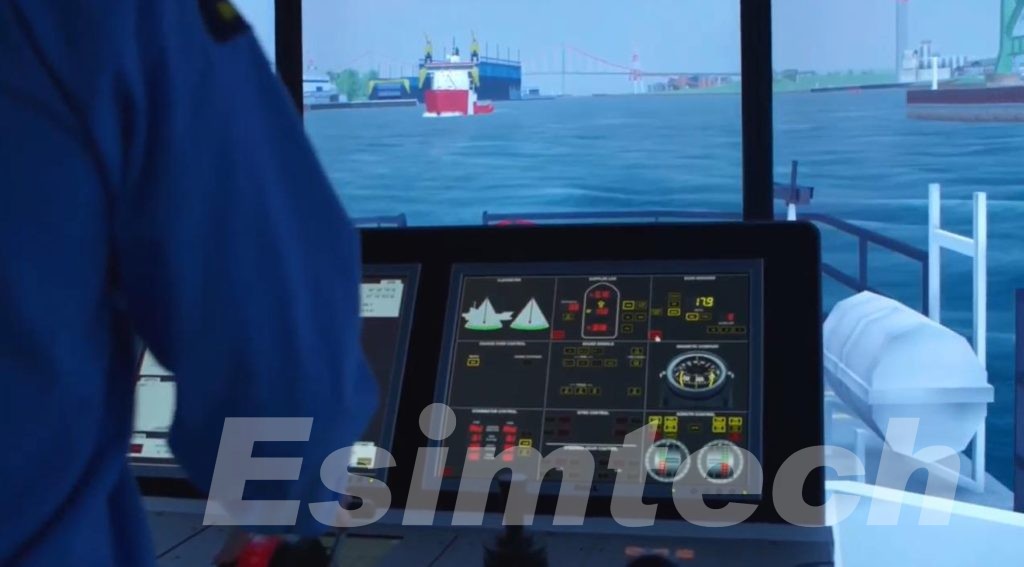
The usefulness of a navigation simulator depends entirely on the mathematical heart. If the software does not correctly mimic the laws of physics, the training is not only useless; it is also dangerous. High-fidelity simulators employ advanced 6-DOF (Six Degrees of Freedom) hydrodynamic modeling to calculate the vessel’s movements (heave, pitch, roll, surge, sway, and yaw).
To effectively prevent an incident, the simulator must calculate complex fluid dynamics, such as:
- Shallow Water Effects: The “Squat” effect, where the draft of a ship rises as it cruises through shallow water, must be accurately simulated to avoid ship ground simulations that are all too realistic.
- Bank Interaction: When a ship navigates near the bank of a channel, asymmetrical pressure causes bank suction and bow cushion. This phenomenon must be simulated to effectively train pilots to react accordingly by adjusting the rudder and/or propulsion.
- Ship-to-Ship Interaction: Simulation of pressure waves that are produced when two large vessels cross each other in a narrow channel is essential to prevent collisions.
The technical approach by Esimtech is centered on achieving these sub-meter accuracies. The simulator’s response to engine and rudder inputs is matched to the sea-trial data of the vessel, which ensures on-the-job training on the bridge. The “Source” and “Support” to this technical claim is achieved by meeting the IMO Model Course 1.22 and STCW 2010 regulations, thus ensuring the equipment meets international maritime safety regulations.
Stress Testing Bridge Teams in Emergency Scenarios
Operational excellence is judged by how well a crew responds to unexpected situations. It is not possible to simulate a complete loss of power or a jammed rudder in a busy area with conventional onboard training. Simulators offer a “sandbox” environment for these catastrophic scenarios.
- Failure Protocol Training: Instructors have the ability to induce a failure of equipment at a critical phase of a maneuver, such as a loss of GPS, a failure of the gyro-compass, or a failure of a thruster.
- Communication & Resource Management (BRM): Incidents are often not caused by technical failures, but by failures in communication between the Pilot, Master, and Tug Captains. Simulation allows for the recording and playback of communications, which enables a rigorous debriefing process where “ego” is replaced by objective facts.
- Infrastructure Testing: Before a port is expanded or a new berth is constructed, simulators are used to “pre-fly” the maneuvers. This allows potential “blind spots” or current issues with channel design to be worked through before construction, saving millions of dollars that could be spent on rework or accidents.
Long-Term ROI: From Safety Compliance to Operational Excellence
The investment in high-end navigation simulators can be justified based on measurable metrics for Return on Investment (ROI). Safety is not a “soft” issue but a bottom-line imperative.
- Insurance Premium Reduction: Many insurance underwriters acknowledge simulator training as a forward-looking approach to risk management, which can translate into better hull and machinery (H&M) or Protection and Indemnity (P&I) insurance conditions.
- Reduced Downtime: By training the crew to operate the vessel more efficiently in bad weather, the port authorities can extend their operating hours safely, reducing the time spent at anchor waiting for “perfect” conditions.
- Legal Protections: In the event of a maritime investigation, having a documented record of rigorous and high-fidelity simulator training can help to demonstrate a company’s commitment to “due diligence” and the highest standards of safety.
As maritime complexity increases, high-fidelity navigation simulators have moved beyond a training nicety to an operational requirement.
Esimtech responds to this need with simulation technology that is industry-leading, featuring accurate 6-DOF hydrodynamic simulations and STCW environments to guarantee that bridge teams are ready to face the most demanding waters on the planet. Our simulation systems are designed to make safety policies a reality, lowering risk exposure and improving crew effectiveness.
Take your maritime safety to the next level with Esimtech’s simulation solutions.
Contact our technical team today for a custom navigation scenario demo.