How a Petroleum University Uses a Drilling Simulator for Well Control Training?

Written By: Computer Science Professor
Deeply rooted in the R&D of simulators for the oil and gas industry, committed to bringing safety to every oil worker.
Students majoring in petroleum engineering may have theoretical knowledge of formation pressure, static water pressure and well control procedures. However, when facing constantly changing well conditions, merely mastering formulas and operation procedures is not sufficient.
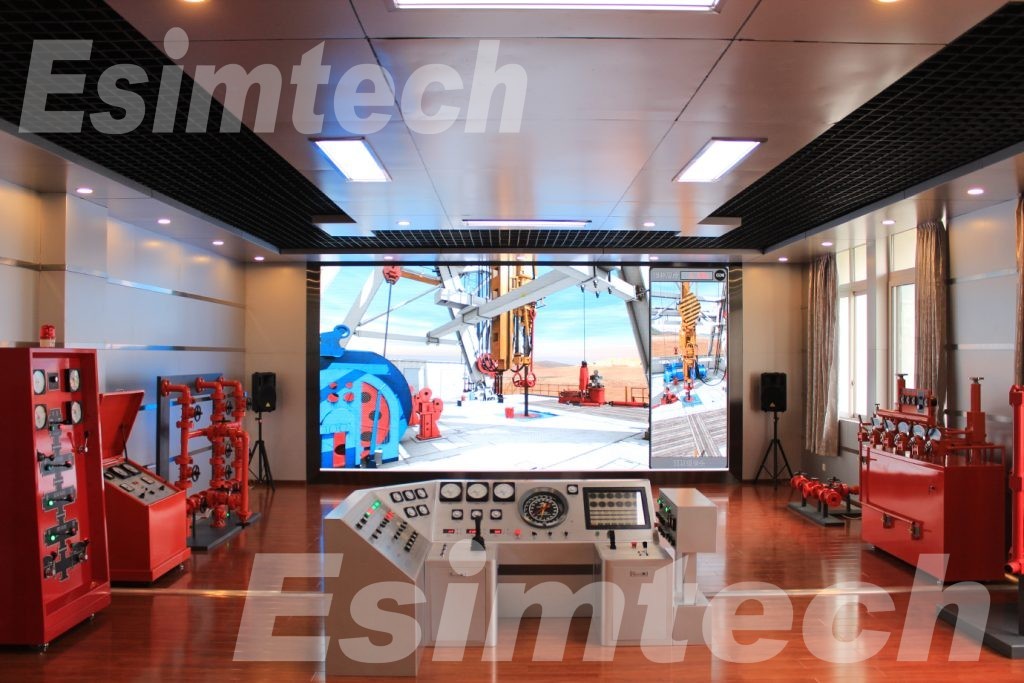
The drilling simulator connects classroom theory with on-site operations, allowing students to experience different well conditions in a controlled environment, practice actual operations, and evaluate the results of decisions.
For petroleum universities, the key is not just to install the simulator, but how to effectively integrate it into well control training.
From Petroleum Engineering Theory to Simulator-Based Training
Well control education usually begins with classroom teaching, where students need to first understand the basic principles involved in the simulation training.
Typical topics include:
- Formation pressure and fracture pressure
- Static water pressure and wellbore pressure
- Causes and detection of well blowouts
- Spill prevention system and well shut-in procedures
- Well control methods and pressure control
After mastering this basic knowledge, the drilling simulator can further introduce dynamic well conditions that cannot be reflected by textbooks and calculations.
For example, the teacher can set up a simulated well with specific formation conditions and drilling parameters, allowing students to monitor changes in pressure, flow rate, and well bottom liquid volume while assessing the well condition.
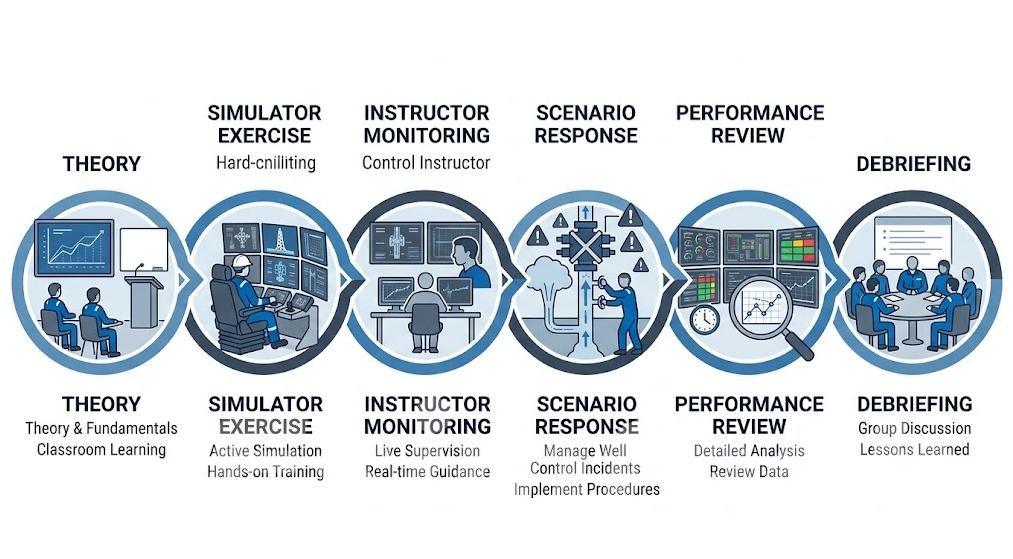
The learning process can be summarized as:
Theory → Simulation → Observation → Decision → Operation → Review
The simulator does not replace petroleum engineering theory; instead, it enables students to apply theoretical knowledge to practical operations in the face of well condition changes.
How Students Practice Well Control on a Drilling Simulator
Typical exercises can start with normal drilling operations. Trainees monitor the simulated well and adjust parameters such as pump speed, standpipe pressure, flow rate, and wellbore volume. Subsequently, the instructor introduces abnormal situations.
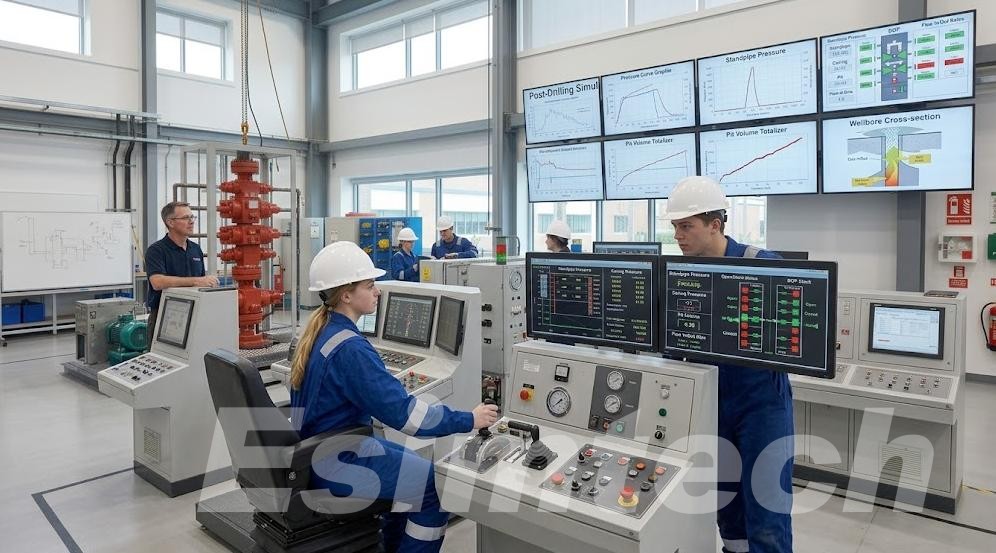
Example: Well Surge Detection and Shut-in
Suppose the simulated well experiences an unexpected increase in flow rate or wellbore volume. Trainees need to determine:
- What changes have occurred in the well?
- Is a well surge possible?
- Which information needs to be checked?
- When should the well be shut-in?
- What should be monitored after the shut-in?
The instructor can adjust the scenario based on the trainees’ operations. After making a correct judgment, they can proceed with pressure monitoring and well control training; if the judgment is incorrect, the simulator will display the corresponding changes in the well condition. This is the advantage of scenario-based well control training: trainees can practice decision-making in dynamic well conditions, rather than memorizing operation steps.
As experience increases, the difficulty of the scenarios can be gradually raised, including:
- Gas migration
- Leakage
- Abnormal formation pressure
- Complex well conditions
- High-angle well scenarios
Increasing the difficulty is not the goal. Each scenario should target specific well control skills and help students understand the consequences of different decisions.
How Instructors Use the Well Control Simulator
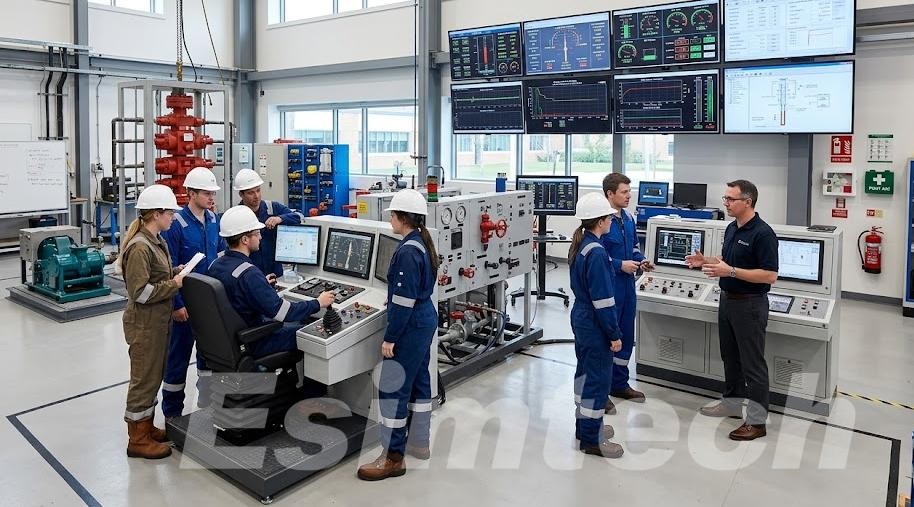
The instructor decides how to integrate the well control simulator into the teaching process.
Before the training begins, the instructor can prepare the well model and training scenario, set the initial conditions, and determine the abnormal events that the trainees will encounter.
During the training, the instructor can monitor:
| Training Area | What the Instructor Observes |
| Well behavior | Changes in pressure, flow, and pit volume |
| Student decisions | Recognition of abnormal conditions and response |
| Operations | Shut-in, pressure control, and well-killing actions |
| Teamwork | Communication and coordination between students |
| Performance | Response time, procedure, and final outcome |
Therefore, the instructor’s workstation is not only used to control the simulator, but also an important teaching tool.
The training content can be adjusted according to the trainees’ levels. Beginners can practice basic well blowout detection and shut-in procedures, while advanced trainees can handle complex scenarios that require multiple decisions.
After the training, the instructor can replay key events, review the trainees’ operations, and have discussions.
The discussions should not only focus on “Did the training complete?” but should focus on “Why did the oil well react in this way? Why was this response chosen?” By summarizing, instructors can link the simulation training experience with the relevant engineering principles.
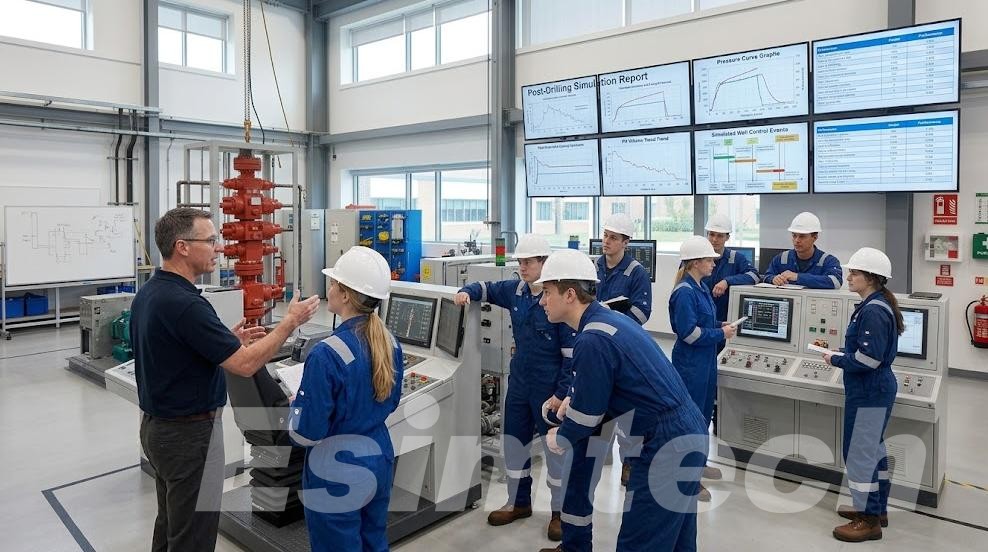
Building Practical Well Control Skills Through Simulation
The value of the drilling simulator does not lie in the equipment itself, but in the learning process built around it.
Students may understand the theoretical methods for dealing with blowouts, but simulation training enables them to make judgments and take actions when blowout signs appear, and to understand the consequences of different decisions.
Through repeated training, students can gradually develop the following skills:
- Identifying abnormal well conditions
- Interpreting pressure and flow information
- Applying well control procedures
- Communicating decisions with the team
- Dealing with sudden changes
- Understanding the consequences of operational decisions
This is particularly important in petroleum engineering education. Well control is not a purely theoretical discipline. Engineers and drilling personnel need to comprehensively analyze multiple pieces of information and make decisions based on the actual well conditions. The drilling simulator provides a controllable training environment where students can repeatedly practice these skills while avoiding the risks of actual well site operations.
Therefore, for universities, the drilling simulator can become an effective tool for connecting theoretical knowledge with practical drilling experience.
Final
In petroleum colleges, integrating the drilling simulator into the curriculum system is more valuable than using it merely as a laboratory equipment.
By combining classroom theory, well control scenarios, teacher guidance, practical training and post-class review, universities can help students better understand the well control decision-making process systematically.
Esimtech provides drilling and well control simulation systems for petroleum colleges and training institutions, and can offer configurable solutions based on different teaching goals and training environments.