Deepwater Wireline Interventions: Mastering HPHT Risks, Subsea Access, and Workforce Simulation

Written By: Computer Science Professor
Deeply rooted in the R&D of simulators for the oil and gas industry, committed to bringing safety to every oil worker.
Deepwater well intervention is one of the riskiest and most costly operations in offshore oil and gas extraction. At depths exceeding 1500 meters beneath the sea surface, operators need to perform precise mechanical operations and real-time cable logging through the underwater wellhead.
Under these conditions, the daily rental cost of a semi-submersible drilling platform or a remote-lift well intervention vessel (RLWI) can reach several hundred thousand dollars. Cable breakage, downhole sticking, or seal failure not only result in data loss but also cause significant non-productive time (NPT) losses and serious well control risks.
To ensure the success of the submarine cable operation, it is necessary to overcome the extremely high-temperature and high-pressure (HPHT) challenges, precisely compensate for the cable tension fluctuations caused by the ship’s pitch, and complete in-depth training for personnel through high-fidelity dynamic simulation before the tools are lowered into the subsea blowout preventer/lubricator.
Comparing Wireline Technologies in Subsea Applications
The selection of the appropriate underground cable operation method depends on the specific working conditions, which may prioritize pure mechanical force, high-speed data transmission, or heavy-load lifting.
Slickline Operations
The wire operation uses high-strength single-core steel wire without a core. Since there is no conductive core inside, the operation is entirely dependent on the mechanical pulling force from the ground.
- Core application: Installing and removing downhole safety valves (DHSV), switching sliding casing liners, setting mechanical bridge plugs, and collecting basic fluid samples.
- On-site advantages: The equipment is lightweight, and the pressure control requirements for the blowout preventer are low. It offers extremely high cost-effectiveness in daily deep-water and deep-well maintenance operations.
- Technical limitations: Real-time underground data cannot be transmitted. Operators can only indirectly determine the status of underground tools by observing changes in the hanging rope device/hanging weight indicator.
Electric Line (E-Line) Operations
Armoured cables achieve high-bandwidth two-way communication between underground tools and the ground collection system by wrapping the insulated conductors.
- Typical applications: formation evaluation logging, production profile testing, casing/mechanical integrity inspection, and selective perforation operations.
- On-site advantages: Provide real-time underground data streams, precise dynamic depth control, and immediate feedback confirmation for tool operations.
- Technical limitations: In high-angle and large-diameter inclined shafts, the frictional resistance of the cable significantly increases; high temperatures, high pressures, and strong corrosive media can easily cause the outer armor to accelerate aging and fail.
Braided Line Operations
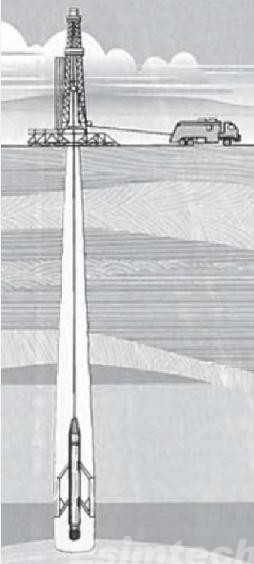
Braided Line is made of multiple steel wires and has a larger outer diameter and extremely high mechanical strength. Some of the internal wire-embedded models can also meet the requirements of heavy-duty logging.
- Typical applications: Heavy-duty underground salvage operations, shock-jetting to dislodge stuck objects, and extraction of deep-sea high-resistance blocking materials.
- On-site advantages: Possesses extremely high tensile strength, meeting the requirements for large tension and high load operations.
Technical Performance & Deployment Comparison
Modern subsea well interventions require matching tool capabilities with dynamic wellbore conditions.
| Wireline Type | Primary Function | Real-Time Data Transmission | Tensile Strength | Main Operational Limitation |
| Slickline | Mechanical plug/valve setting | None (Mechanical weight monitoring) | Moderate | Restricted to basic mechanical tasks |
| E-Line | High-precision logging & perforation | High-bandwidth live telemetry | Moderate to High | Armor degradation in sour HPHT environments |
| Braided Line | Heavy fishing & heavy jarring | Optional (Conductive braided) | Extremely High | Requires larger pressure control equipment |
Engineering Challenges in Deepwater Interventions
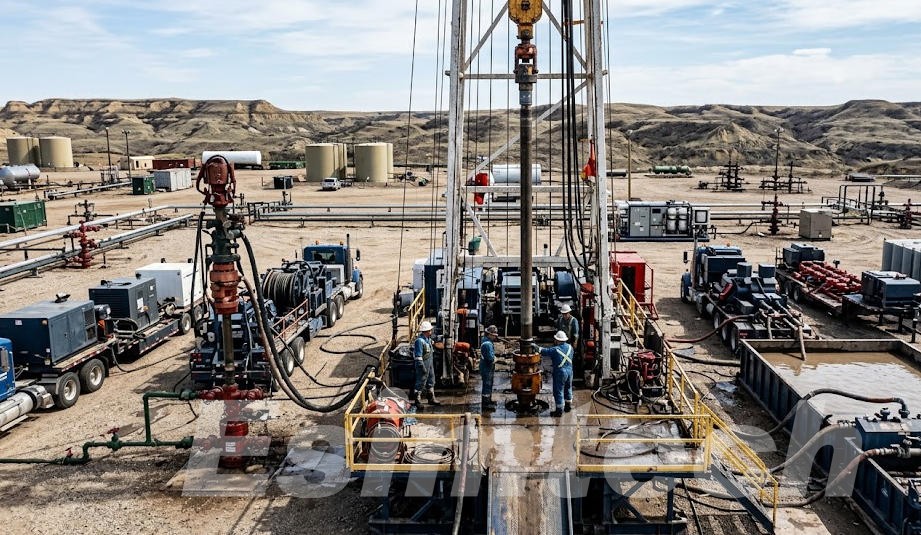
Underwater production tree without riser operation faces severe physical challenges that are not present on land or on fixed platforms:
- Cable stretching and tool failure under high-temperature and high-pressure (HPHT) conditions: The pressure in offshore oil reservoirs often exceeds 15,000 psi, and the well bottom temperature exceeds 175 ℃. Extremely high pressure can cause significant elastic stretching of the cables, resulting in depth measurement errors; while the high-temperature and high-pressure medium will accelerate the wear of seals and the failure of downhole electronic components.
- Ship body motion and pitch compensation: When operating on a monohull RLWI vessel or a semi-submersible platform, waves can easily cause vertical movements. The high-performance active pitch compensation (AHC) system equipped on the cable winch is crucial for preventing tool strings from bouncing, avoiding cable breakage, and protecting the precision instruments inside the blowout preventer (BOP).
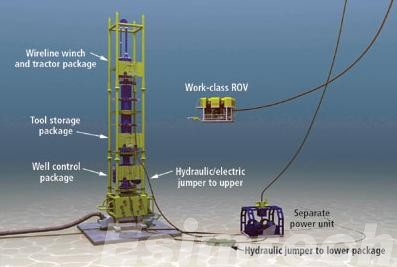
- Underwater pressure control and lubricator assembly: When entering the underwater wellhead without a riser, it must rely on the underwater lubricator system (SLA). Under deep-water static water pressure, the grease injection sealing performance must be continuously optimized to maintain the high-pressure dynamic sealing of the moving cable, which requires extremely high precision for the operation.
How Simulation Eliminates Non-Productive Time (NPT)
During underwater operations, blindly conducting trial-and-error tests of downhole tools will lead to disastrous consequences. Dynamic simulation bridges the gap between engineering design and efficient offshore operations in practice.
- Pre-job simulation analysis: Before the tool string is lowered into the well, engineers use dynamic simulation software to predict the tension of the steel wire rope, the friction force of the pipe wall, and the fluid resistance in the highly inclined wellbore. The system can accurately assess key operational limits (such as the maximum safe tension) and identify potential areas of differential pressure that could cause stuck drill bits.
- Risk management for complex salvage operations: If the steel wire rope breaks underground, recovering the fallen tool string (for salvage) will pose an extremely high risk. By simulating the geometric and physical characteristics, as well as the shock and tensile mechanics of the salvage tools, the engineering team can pre-verify the salvage plan and avoid potential misoperations that could cause permanent damage to the wellbore.
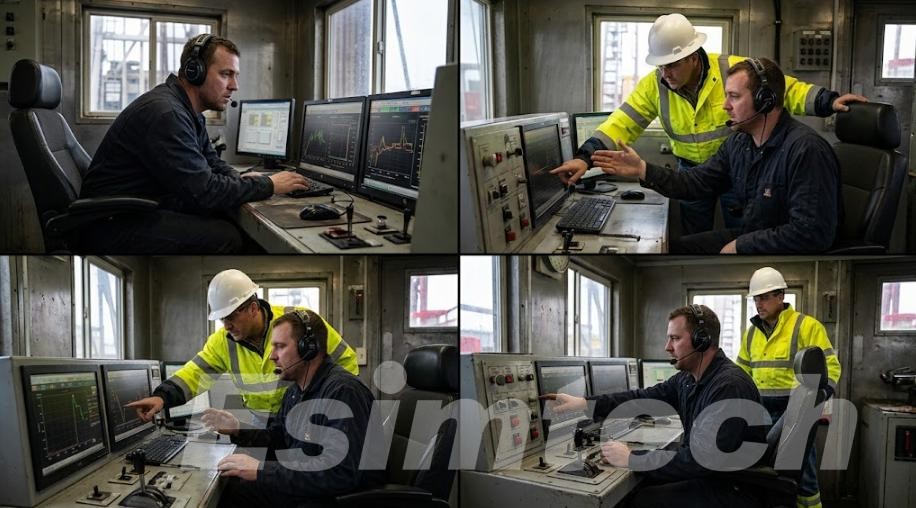
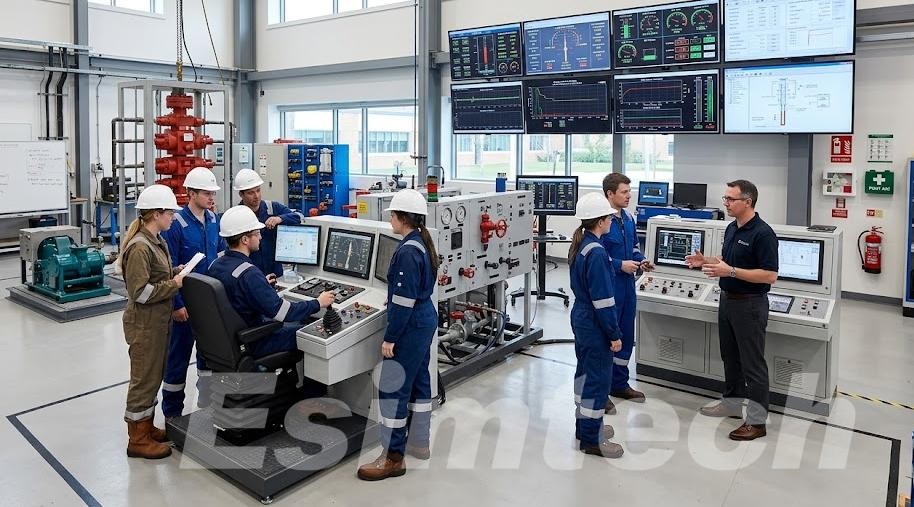
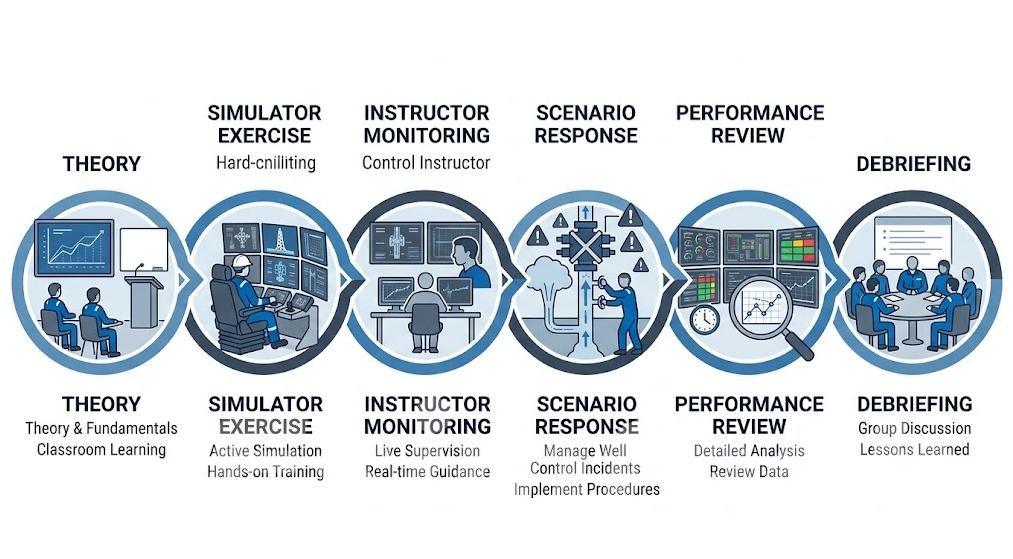
- Operator Immersive Training (OTS): Human error remains the primary cause of non-productive time (NPT) at sea. By leveraging high-fidelity simulation systems – such as the Esimtech downhole operation simulator, the control cabin of the cable operation winch, the pressure control panel at the seabed wellhead, and the dynamic physical processes in the wellbore can be realistically replicated. Operators can conduct full-scenario practical exercises and easily handle emergencies such as pipeline blockages, failure of grease seals for blowout preventers, stuck pipes, and sudden well surges.
Best Practices for Deepwater Wireline Execution
To ensure the integrity of the wellbore and maximize the return on investment (ROI) for offshore operations, the on-site team should follow the following standard operating procedures:
- Precise tension modeling before implementing refined operations: Before conducting the underground operation, accurately calculate the maximum pipeline tension, the elongation rate of the steel wire, and the overload curve at weak points.
- Verify the grease injection sealing system: Test the sealing performance of the subsea lubricator and verify whether the viscosity of the grease matches the expected well bottom temperature and pressure (HPHT) conditions.
- Active Hoisting and Descending Compensation System (AHC): Real-time synchronization of winch speed with ship displacement to prevent collision between blowout preventer and downhole tools as well as rupture of pipelines.
- Enhancing drills through high-fidelity simulators: Utilizing advanced simulators to assess operators and ensure that they can quickly and standardly respond to emergencies such as well-bore stuck drill bits or pressure surges.
Final Thought
Deepwater cable operations are a crucial means for maintaining reservoir production capacity, extending the lifespan of subsea production trees and oil fields. By integrating highly reliable downhole tools, precise ground wave motion compensation systems, and combining with practical exercises based on dynamic simulation platforms, offshore operators can effectively manage high-temperature and high-pressure (HPHT) risks and achieve the goal of safe and zero non-productive time (NPT) operations.