Drilling Simulator vs. Drilling Animation: What Is the Difference?

Written By: Computer Science Professor
Deeply rooted in the R&D of simulators for the oil and gas industry, committed to bringing safety to every oil worker.
Drilling simulators and drilling animations can both visualize drilling equipment and operation procedures, but their training purposes are different. The key difference does not lie in how realistic the 3D graphics or the appearance of the equipment are, but rather in how the trainees can use these technologies.
Drilling animations are mainly used to demonstrate the process, while drilling simulators allow trainees to interact with the process and practice operations.
Understanding this difference can help drilling companies, training centers, and educational institutions select the appropriate solution based on specific training needs.
Drilling Animation vs. Drilling Simulator: The Key Difference
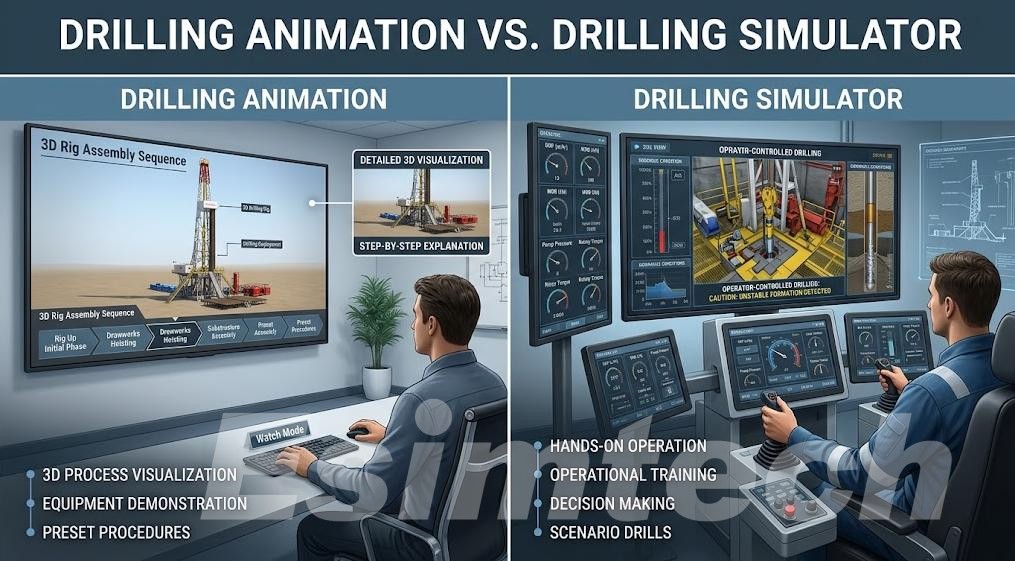
The fundamental difference lies in the viewing process and the actual operation.
| Feature | Drilling Animation | Drilling Simulator |
| Primary purpose | Visualization | Interactive training |
| User interaction | Limited | High |
| Process | Predefined | Interactive |
| Repetitive practice | Limited | Strong |
| Decision-making | Limited | Supported |
| Performance feedback | Limited | Available depending on system |
The drilling animation runs in a preset sequence, allowing the display of the movement, assembly, and specific operations of the equipment components. This is very helpful for explaining processes that are difficult to understand solely through drawings, photos, or text.
The drilling simulator, on the other hand, emphasizes interaction. Trainees can operate the simulation control devices, respond to changing situations, and observe the system’s response to the operations.
In summary, the animation helps trainees understand the process, while the simulator allows them to practice the operations.
When Is Drilling Animation the Better Choice?
When the training focus is on visual explanations rather than actual operations, drilling animations are particularly effective.
For instance, 3D animations can break down the complex installation process of land drilling rigs into clear steps, showing how components are positioned and assembled, and also presenting the movements of equipment that are difficult to observe directly during actual operations.
Typical applications include:
- Equipment and process visualization: Displaying drilling components, structures, and equipment movements.
- Step-by-step operation demonstrations: Showing processes such as land drilling rig installation, component assembly, derrick installation, and derrick lifting.
- Classroom and training materials: Used for lecturers’ teaching, demonstrations, induction training, and digital learning.
Animations can also provide consistent process explanations for different trainees.
When the goal is to help people observe, understand, and remember operation procedures, drilling animations are an efficient training tool.
When Does a Drilling Simulator Provide More Value?
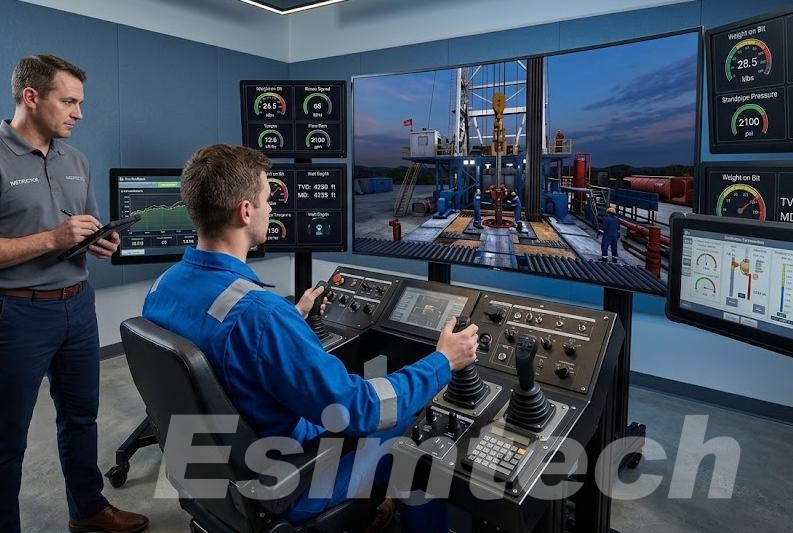
When the training needs to transition from visual understanding to skill development, the drilling simulator becomes even more valuable.
Students no longer merely watch preset animations; instead, they can operate the simulation equipment and control devices, such as the drilling rig control device, top drive, winch, pump, and hydraulic equipment.
The simulator can respond in real time based on the students’ operations and changing conditions, creating a more interactive training environment.
Repetition practice
Students can repeatedly practice the same operation:
Practice → Make mistakes → Review → Reset → Repeat practice
This is particularly useful for processes that rely on time, operation sequence, and precise control.
Scenario training
The simulator can also introduce scenarios that are difficult or not suitable for performing in normal drilling operations, allowing students to practice responding to abnormal situations, equipment failures, and emergencies.
Therefore, when the training goal is not only to understand the operation process but also to practice how to deal with emergencies, the simulator has an advantage.
Which One Should You Choose—or Should You Use Both?
The right choice depends on the training objective.
| Training Objective | Recommended Solution |
| Explain equipment | Animation |
| Demonstrate a procedure | Animation |
| Classroom visualization | Animation |
| Operator practice | Simulator |
| Repetitive training | Simulator |
| Abnormal scenario training | Simulator |
| Performance assessment | Simulator |
However, animation and simulation do not necessarily compete with each other.
They can form different stages of the same training program:
Animation → Understanding
↓
Simulation → Practice
↓
Practical operation → Application
Animation can first introduce the equipment and processes. Simulation allows trainees to practice operations and handle different scenarios. Finally, guided training on the actual operation platform can provide an actual operation experience and environment that simulation cannot fully replicate.
Therefore, for institutions with broader training needs, combining these two technologies can offer a more complete learning path.
Esimtech Drilling Simulation and Animation Solutions
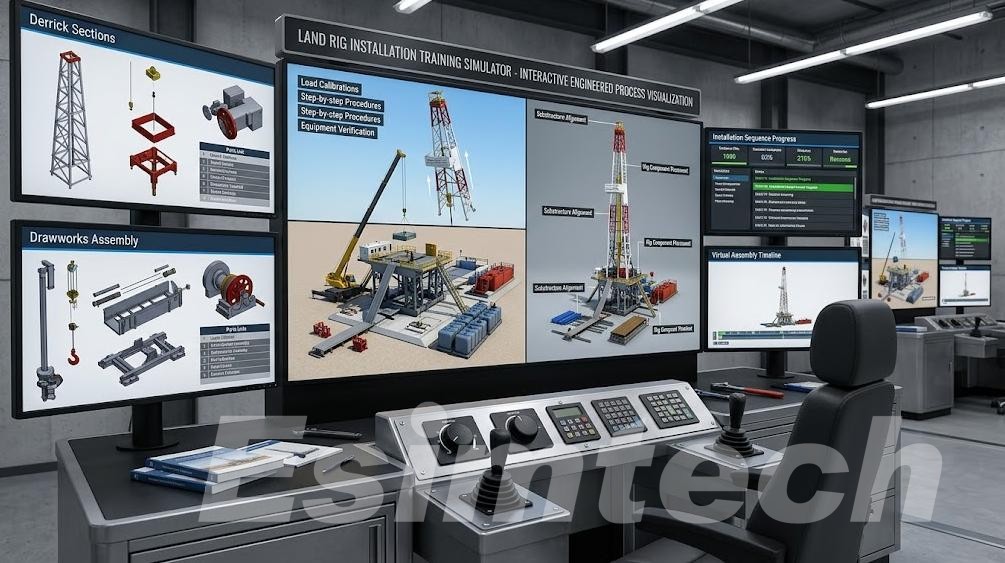
ESIMTECH offers industrial drilling animations and interactive drilling simulation systems to meet various training needs.
The land drilling rig installation animation focuses on presenting the complete installation process, including component installation and the lifting of the derrick, and is suitable for process demonstrations, equipment familiarization, and visual training.
For scenarios that require interactive training, the ESIM-FLR2 land drilling rig installation simulator combines the installation of the drilling rig with virtual assembly, the lifting of the derrick and the lower support, as well as the simulation of drilling operations.
The differences between the two illustrate the core purposes of these two technologies:
The drilling animation shows how the process operates; the drilling simulator allows trainees to practice how to execute the process.
Ultimately, the choice of which solution to use, or the combination of both, depends on whether the training goal is visual understanding, operational practice, or a combination of both.