Offshore vs. Onshore Oil Transportation

Written By: Computer Science Professor
Deeply rooted in the R&D of simulators for the oil and gas industry, committed to bringing safety to every oil worker.
Oil transportation is one of those really critical pieces in the worldwide energy supply chain; it basically makes sure that crude oil and refined petroleum products can get around smoothly from where they’re made to refineries, storage sites, and then eventually the end-users. And depending on where the oil comes from, like if it’s coming from offshore areas or more inland zones, the ways it gets moved can change a lot. There are really two main kinds of oil transportation: offshore and onshore. Offshore is about shifting oil from offshore production platforms out in oceans and seas, while onshore takes care of oil coming from land-based fields. They both aim at the same outcome, but the daily setup is not the same; there are differences in infrastructure, different operational challenges, costs, and environmental considerations.
Understanding Offshore Oil Transportation
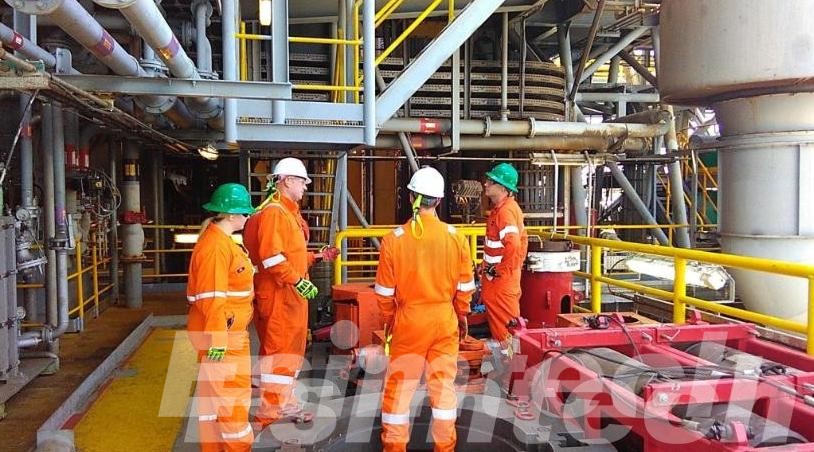
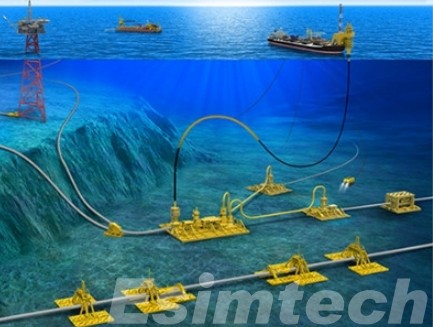
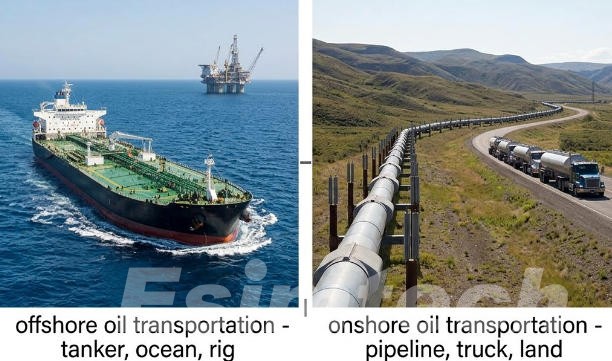
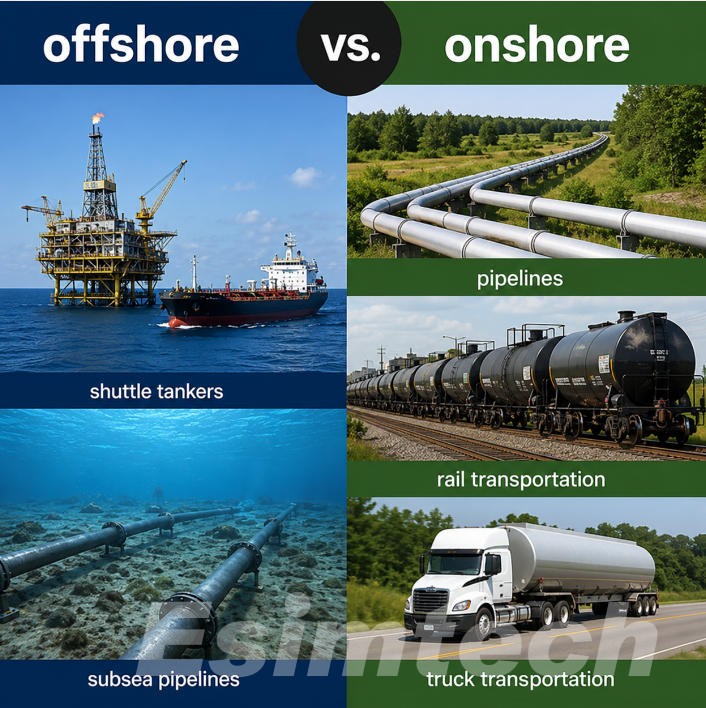
Offshore oil transportation, in plain terms, is the process of moving crude oil that was extracted from offshore oil fields toward onshore processing facilities or distribution networks. Usually, offshore production happens on fixed platforms, floating production units, or subsea production systems placed miles offshore, not near the coastline.
After the oil is pulled out, it gets moved using a few common routes, like subsea pipelines, shuttle tankers, and floating storage systems. The final pick between these options depends on things like how deep the water is, how much oil is being produced, how far the site is from shore, what infrastructure is already there, and what the numbers look like economically.
Common Methods
| Transportation Method | How It Works | Applications | Advantages |
| Subsea Pipelines | Oil is transported through pipelines installed on or beneath the seabed from offshore platforms to onshore terminals. | Mature offshore fields with long-term production. | Continuous flow, high capacity, lower operating costs over time. |
| Shuttle Tankers | Specialized tankers collect crude oil from offshore facilities and transport it to coastal terminals or refineries. | Remote offshore fields without pipeline infrastructure. | Flexible routing, lower initial investment than pipelines. |
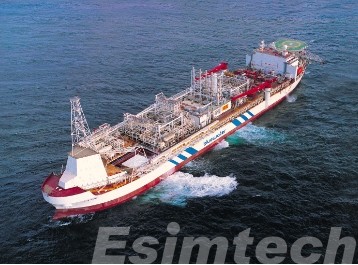
| Floating Production Storage and Offloading (FPSO) Units | FPSOs process, store, and transfer oil directly at sea to shuttle tankers. | Deepwater and ultra-deepwater oil fields. | Eliminates need for immediate pipeline connections, highly flexible. |
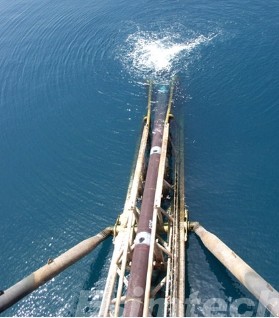
| Single Point Mooring (SPM) Systems | Offshore loading buoys allow tankers to load crude oil from subsea pipelines or storage facilities. | Export terminals located offshore. | Enables loading of large tankers in deep water. |
| Floating Storage Units (FSUs) | Offshore vessels or converted tankers store oil temporarily before transfer to transport vessels. | Areas with limited onshore storage capacity. | Additional storage flexibility, supports continuous production. |
| Barge Transportation | Barges transport oil between offshore facilities and nearby coastal locations. | Shallow-water fields and short-distance transport. | Cost-effective for smaller volumes and short routes. |
In today’s offshore projects, subsea pipelines along with FPSOs kinda lead the way as the main transportation options, while shuttle tankers still matter a lot because they bring flexibility for remote and deepwater oil fields, especially where laying a pipeline isn’t economically realistic.
Understanding Onshore Oil Transportation
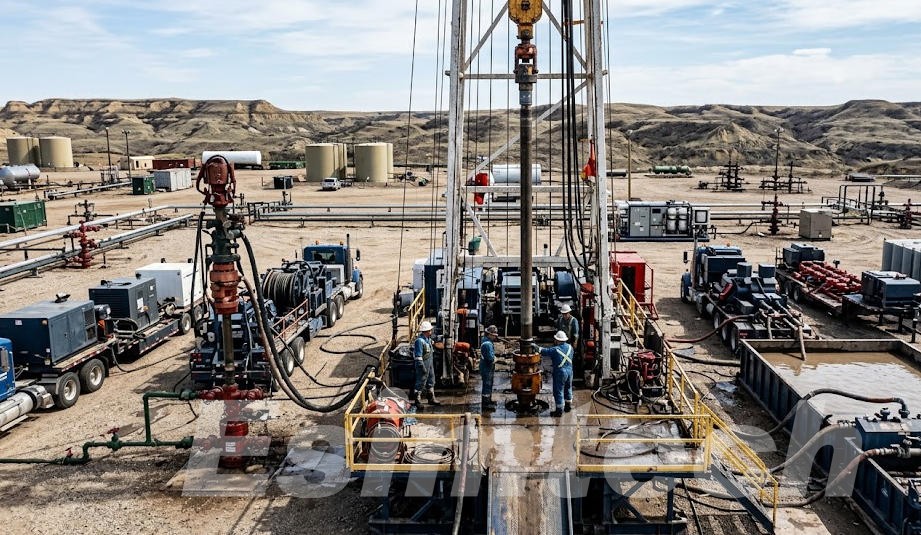
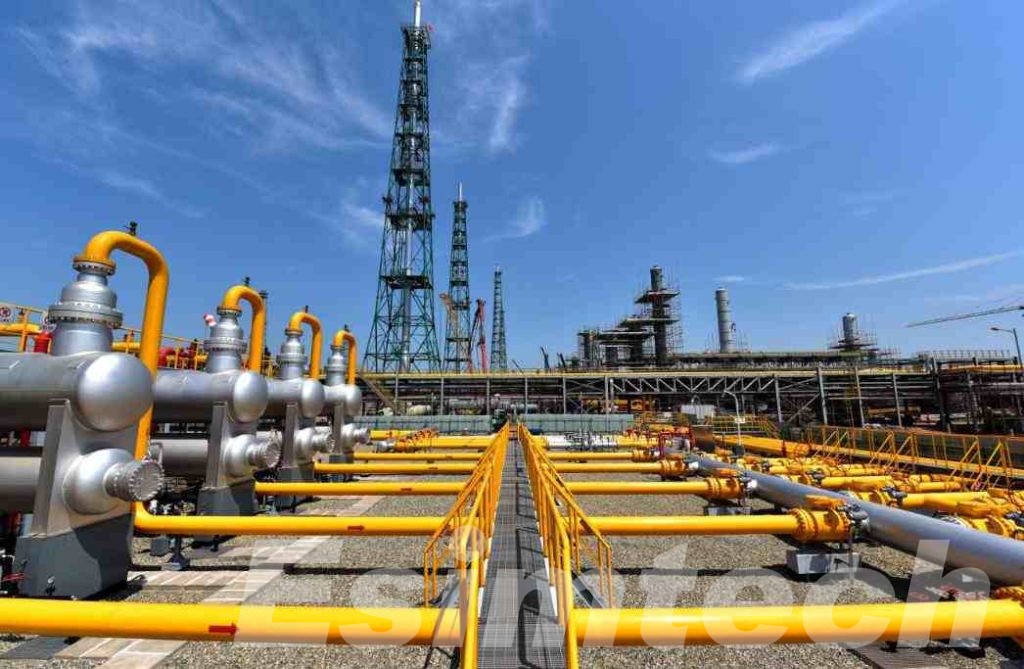
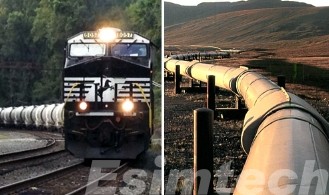
Onshore oil transportation is basically about moving crude oil and other petroleum products across land, from where it is produced to the places where it gets refined, processed, and later distributed. Depending on how far it has to go, how much there is to move, the land shape, and what infrastructure already exists, the oil might end up traveling by pipelines, trucks, rail networks, or even inland waterways.
Which option gets picked usually comes down to economic pressures, the production output you’re dealing with, local geography, and also regulatory rules. In a lot of areas, people end up using a mix of methods, so the system stays efficient and more or less dependable as a whole.
Common Methods
| Transportation Method | How It Works | Applications | Advantages |
| Pipelines | Transport crude oil continuously through underground or above-ground pipeline networks. | Long-distance transportation from oil fields to refineries and terminals. | High capacity, cost-effective for large volumes, reliable operation. |
| Tank Trucks | Road tankers transport oil from production sites to storage facilities or processing plants. | Short-distance transport and remote oil fields. | Highly flexible, accessible to areas without pipelines. |
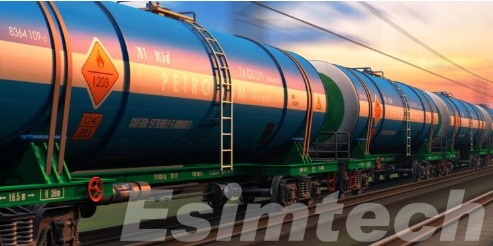
| Rail Transportation | Specialized rail tank cars move crude oil and petroleum products over long distances. | Regions lacking pipeline infrastructure or requiring flexible routing. | Large carrying capacity and extensive rail network access. |
| Inland Barges | Barges transport oil through rivers, canals, and inland waterways. | Areas with navigable waterways and bulk transportation needs. | Cost-effective for large volumes, lower fuel consumption per ton-mile. |
| Multimodal Transportation | Combines pipelines, trucks, rail, and barges within a single logistics network. | Complex supply chains and large distribution networks. | Maximizes efficiency and flexibility. |
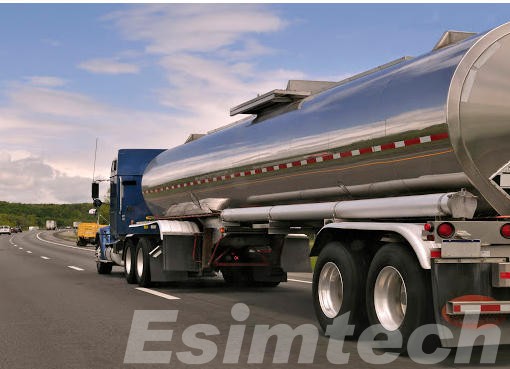
Pipelines remain the dominant method of onshore oil transportation, mainly because they can push huge volumes without much interruption and at a lower cost over long distances. When pipeline access is limited, rail hauling and inland barges turn into practical alternatives, while tank trucks are preferred for shorter runs or remote field conditions. More and more, multimodal setups are being used, like pairing rail, road, and pipeline segments, so logistics can be tuned across the more complex parts of an oil supply chain.
Key Differences Between Offshore and Onshore Oil Transportation
| Aspect | Offshore Oil Transportation | Onshore Oil Transportation |
| Production Location | Offshore platforms, subsea wells, and floating production facilities located in oceans and seas. | Land-based oil fields and production facilities. |
| Primary Transportation Methods | Subsea pipelines, shuttle tankers, FPSOs, and offshore loading systems. | Pipelines, tank trucks, railways, barges, and multimodal networks. |
| Infrastructure Complexity | Highly complex marine infrastructure requiring specialized engineering. | Relatively simpler and more accessible infrastructure. |
| Installation Cost | Very high due to subsea construction and offshore equipment requirements. | Generally lower due to easier land access and construction. |
| Maintenance Accessibility | Difficult and costly; often requires specialized vessels and equipment. | Easier and faster access for inspections and repairs. |
| Transportation Flexibility | Limited transportation options once infrastructure is established. | Multiple transportation modes provide greater flexibility. |
| Weather Impact | Highly affected by storms, hurricanes, typhoons, and rough seas. | Less vulnerable to marine weather but can be affected by extreme land conditions. |
| Typical Transportation Capacity | High capacity through subsea pipelines and large tankers. | High capacity through extensive pipeline networks and rail systems. |
Key Factors to Consider for Choosing Between Offshore and Onshore Oil Transportation
Choosing the right approach for oil transportation is a real important step during oil and gas project development. Whether to use offshore or onshore routes depends mostly on where those reserves are sitting, but there are also a bunch of other technical, financial, environmental, and daily operating things that can not be ignored.
1. Location of Oil Reserves
The exact location of the oil field is the key base point for deciding the transport method.
For offshore oil fields that are under oceans or deeper water areas, the plan usually leans toward offshore transportation systems like subsea pipelines, shuttle tankers, or FPSO units. On the other hand, land-based oil fields tend to be supported by onshore transportation networks. These networks may involve pipelines, rail lines, trucks, and inland barges.
Since the reserve location drives what infrastructure is needed, it becomes the first step in transport planning, even before detailed design begins.
2. Transportation Distance
The distance between production facilities, and processing or export terminals, tends to shape transportation economics in a major way. When it stretches far, costs rise, and the whole plan can lean one direction or another.
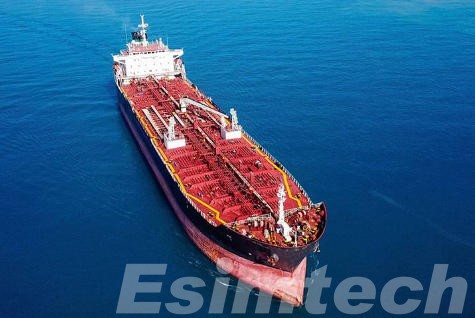
For offshore projects that are placed relatively close to shore, subsea pipelines may end up being the most efficient option, in practice. But for remote offshore fields sitting hundreds of kilometers away from land, shuttle tankers, or FPSOs, can deliver more flexibility, and in many cases lower total expenses.
In the same spirit, onshore projects that must cover long transportation distances often lean toward pipelines because of their strong throughput and cost-effectiveness. On the other hand, shorter connections may be adequately handled by trucks, or rail networks.
3. Capital Investment Requirements
Infrastructure costs do not stay the same, they change a lot between offshore and onshore transportation systems.
Offshore transportation usually calls for bigger capital outlays. That is mainly because of specialized equipment, subsea pipeline installation, marine vessels, offshore loading systems, plus the more involved engineering requirements that come with it.
Onshore transportation infrastructure is usually less costly to build and maintain, because it is more accessible and the working conditions are less demanding. Companies really have to take time to weigh their project budgets with expected returns, when deciding on transport approaches.
4. Production Volume and Capacity Needs
What production volume is expected to be, matters a lot in choosing how to move materials.
If it is a large-scale production plan, it often makes sense to invest in specialized pipeline systems, since pipelines deliver a steady flow and high-capacity transport. But for smaller operations, or temporary needs, people often lean toward more adaptable options like tankers, trucks, or rail systems.
When the transport capacity is matched to the predicted production volumes, it helps prevent situations where equipment sits idle, and it also reduces extra spending that was unnecessary.
5. Environmental Considerations
Environmental safeguards are becoming more and more important in transportation planning.
Offshore transportation systems need to deal with the hazards tied to marine oil spills, these events can mess with ocean ecosystems, fisheries, and nearby coastal communities. On land transportation systems have their own problems, including soil contamination, guarding groundwater, and the knock-on effects for the people living there.
When companies compare transportation alternatives, they should really look closely at how sensitive the environment is, whether their spill response ability is strong, what the rules demand, and how their sustainability aims fit in.
6. Infrastructure Availability
Existing infrastructure can sway transportation decisions in a major way, often more than people expect.
If pipeline networks, storage terminals, ports, rail facilities, or loading systems are already there, companies can frequently lower project costs by making use of those in place assets. However, going with brand new infrastructure can mean bigger spending and longer project schedules. It is better to take time to evaluate what is available so the transportation economics improve, and project development moves faster.
7. Regulatory and Permitting Requirements
Transportation projects have to meet a large number of environmental, safety, and operational rules.
Offshore operations are usually tied to tight maritime regulations, offshore safety standards, and environmental protection requirements. For onshore projects, teams need to handle land-use regulations, the permitting process, pipeline approvals, plus neighborhood or community concerns; that part often gets overlooked in early drafts.
Getting a clear view of regulatory obligations at the start of planning can help prevent schedule setbacks and surprise expenses.
Challenges in Offshore vs. Onshore Oil Transportation
| Challenge Area | Offshore Oil Transportation | Onshore Oil Transportation |
| Capital Investment | Requires costly offshore platforms, subsea pipelines, FPSOs, and marine support systems. | Requires pipelines, rail networks, storage terminals, and trucking infrastructure, generally at lower cost. |
| Maintenance Complexity | Maintenance is difficult due to deep water, remote locations, and specialized equipment needs. | Easier access for inspection and repair, though extensive networks can still be challenging to maintain. |
| Environmental Impact | Offshore spills can damage marine ecosystems, fisheries, and coastal habitats. | Leaks can contaminate soil, groundwater, rivers, and populated areas. |
| Weather Exposure | Highly vulnerable to hurricanes, typhoons, storms, rough seas, and strong currents. | Exposed to floods, landslides, earthquakes, snowstorms, and extreme temperatures. |
| Accessibility | Limited accessibility often requires vessels, helicopters, and offshore service crews. | Generally accessible by road, rail, and conventional maintenance equipment. |
| Safety Management | Emergency response is more complex due to remote offshore locations. | Transportation accidents involving pipelines, trucks, and trains remain significant concerns. |
| Corrosion Risks | Constant exposure to seawater accelerates corrosion and material degradation. | Corrosion occurs mainly due to soil conditions, moisture, and aging infrastructure. |
| Regulatory Requirements | Subject to strict maritime, environmental, and offshore safety regulations. | Must comply with environmental, land-use, transportation, and pipeline regulations. |
| Logistics Coordination | Requires coordination among offshore platforms, vessels, storage units, and terminals. | Requires coordination among pipelines, rail systems, trucking fleets, and storage facilities. |
| Emergency Response Speed | Slower due to remote operating environments and difficult access. | Generally faster because assets are easier to reach and support. |
Technological Innovations for Addressing the Challenges of Offshore and Onshore Oil Transportation
To overcome these challenges in offshore and onshore oil transportation, the oil and gas industry is getting more and more into advanced technologies, that help operational efficiency , boost safety, lower environmental threats, and make asset management smoother. These changes are changing the way oil is hauled around across both offshore settings and onshore areas, even when the terrain is not the same.
1. Smart pipeline monitoring systems
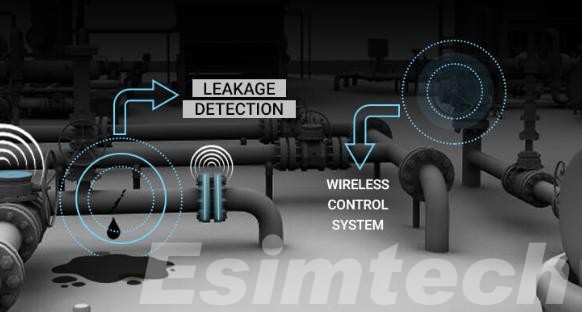
One of the major developments in oil transportation is the rise of smart pipeline monitoring systems. Today pipelines have sensors in place that keep gathering info on pressure, temperature, flow rates, and the real structural state of the line.
With these systems, operators can see what is happening in real time, and they can spot irregular operating conditions fast, so they can identify leaks, blockages, or mechanical breakdowns before they become large scale incidents. With early action, smart monitoring systems reduce downtime, lower upkeep expenses, and also reduce environmental risks.
2. Advanced Leak Detection Technologies
Leak detection is still a big priority for offshore and onshore transportation networks. Old school inspection methods are getting more and more supported by advanced options like fiber optic sensing, acoustic monitoring setups and satellite monitoring.
These approaches can spot even minor leaks fast, and with good precision, so operators can react more effectively. If you catch a leak early it limits product loss, lowers environmental harm, and lets companies meet the increasingly strict environmental requirements.
3. Artificial Intelligence and Predictive Maintenance
Artificial intelligence, AI, is changing how assets are managed across the oil transportation sector. AI driven platforms inspect huge amounts of operational data to find signals that may hint at equipment failures in the future.
Predictive maintenance solutions help plant operators schedule repairs ahead of breakdowns happening, which cuts down on surprise downtime and can extend the life of key assets. This method feels especially useful for offshore facilities, where maintenance work costs a lot and the logistics are challenging.
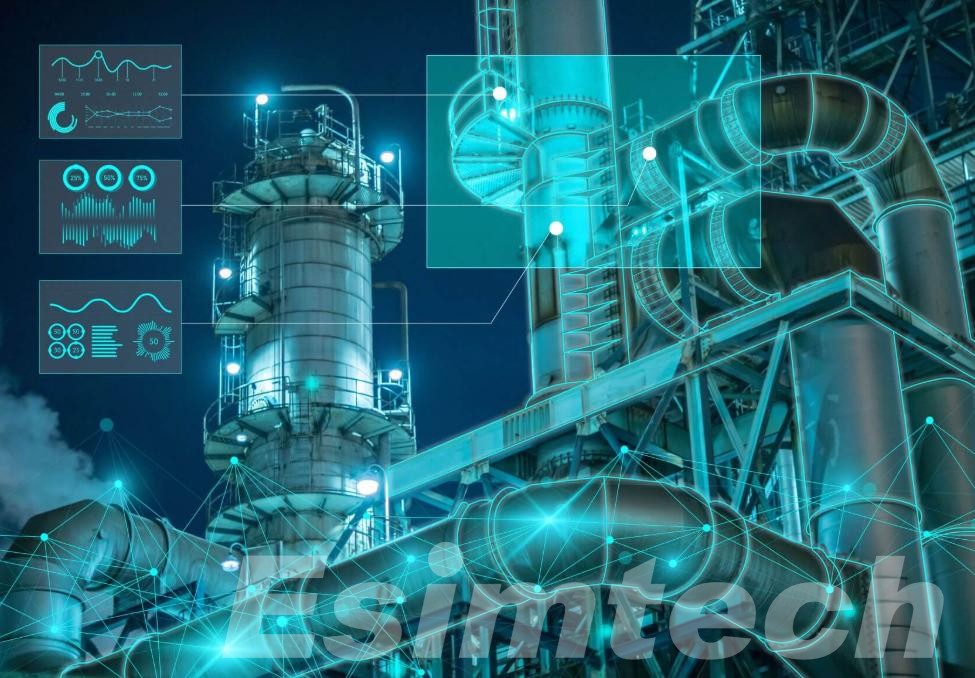
4. Simulation Technologies
Oil transportation simulation technologies are crucial by helping operators predict operational issues, optimize logistics, improve safety, and reduce environmental risks.
| Simulation Technology | Application in Offshore Oil Transportation | Application in Onshore Oil Transportation | Benefits |
| Pipeline Flow Simulation | Models fluid flow through subsea pipelines under varying pressure and temperature conditions. | Simulates crude oil movement through long-distance pipeline networks. | Optimizes flow efficiency, reduces bottlenecks, and improves operational planning. |
| Digital Twin Simulation | Creates virtual models of offshore platforms, subsea pipelines, and FPSOs. | Replicates pipelines, pumping stations, storage terminals, and transportation networks. | Enables predictive maintenance and real-time asset monitoring. |
| Leak Detection Simulation | Simulates offshore leak scenarios and spill dispersion in marine environments. | Models pipeline leaks and product releases on land. | Improves emergency preparedness and response planning. |
| Transportation Logistics Simulation | Optimizes tanker scheduling, offshore loading operations, and marine traffic management. | Simulates truck, rail, pipeline, and storage logistics. | Enhances transportation efficiency and resource utilization. |
| Risk Assessment Simulation | Evaluates offshore hazards such as storms, equipment failures, and subsea incidents. | Assesses risks from pipeline failures, rail accidents, and natural disasters. | Supports safety management and regulatory compliance. |
| Emergency Response Simulation | Models oil spill containment, evacuation procedures, and offshore incident response. | Simulates spill response, firefighting, and evacuation scenarios. | Improves personnel training and response effectiveness. |
| Structural Integrity Simulation | Analyzes stresses on subsea pipelines, risers, and offshore structures. | Evaluates pipeline durability, corrosion effects, and infrastructure aging. | Extends asset lifespan and improves reliability. |
| Weather and Environmental Simulation | Models wave action, ocean currents, storms, and seabed conditions. | Simulates floods, landslides, earthquakes, and extreme weather impacts. | Helps operators prepare for environmental challenges. |
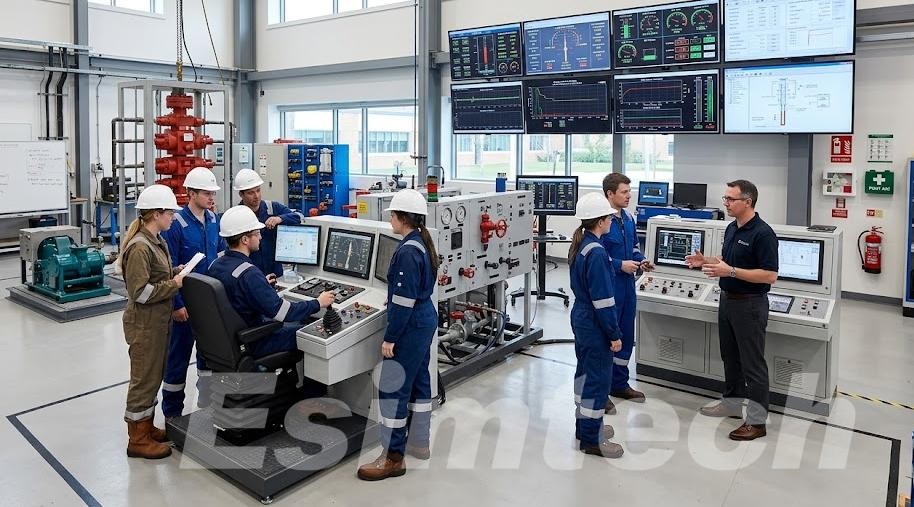
| Operator Training Simulators | Trains personnel on offshore loading, FPSO operations, and emergency procedures. | Trains operators on pipeline control, terminal operations, and transportation management. | Enhances workforce competency and safety performance. |
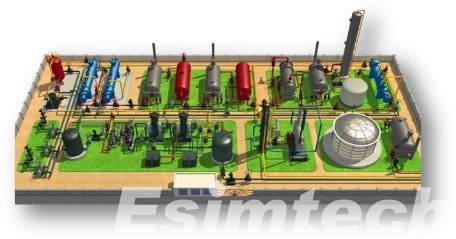
Within those technologies, digital twins, pipeline flow simulation, risk assessment models, and emergency response simulators are starting to matter more, since today’s oil transportation systems deal with increasingly complex issues.
5. Autonomous Inspection Technologies
Inspecting transportation infrastructure tends to be expensive, takes longer than people expect, and can be pretty risky. Lately, autonomous inspection tools are starting to help with those issues, even if they are not a perfect fix.
In offshore areas, remotely operated vehicles, often called ROVs, along with autonomous underwater vehicles, usually AUVs, check subsea pipelines, risers, and offshore platforms. On land, operators are also leaning more toward drones with high resolution cameras, thermal imaging systems, and other advanced sensors, to monitor pipelines and remote facilities.
The main idea here is that these methods can raise inspection accuracy while lowering operating expenses and also reducing worker exposure to unsafe environments.
5. Corrosion Management Innovations
Corrosion is still a big worry for both offshore and onshore transportation networks. Offshore infrastructure gets a constant dose of seawater, while onshore pipelines meet corrosion pressures from soil chemistry, moisture build up, and aging construction materials.
Advancements in corrosion resistant alloys, composite matter, protective surface layers, and cathodic protection setups are helping to stretch asset life and cut back on routine upkeep. Better corrosion management, really, boosts operational reliability and also improves safety measures.
6. Automated Control and Remote Operations
Automation technologies are pushing down the need for hands on involvement in transportation operations. Advanced control systems can automatically tweak flow rates, keep an eye on equipment performance, and react to changing operating situations which happen during the day.
Remote operation centers let staff monitor huge transportation networks from one centralized spot. This ability is especially helpful for offshore facilities that are far from shore, and also for extensive onshore pipeline systems, that stretch across wide geographic territories.
7. Geographic Information Systems (GIS) and Route Management
Geographic Information Systems (GIS) have turned into useful instruments for handling transportation infrastructure. GIS blends geographic, environmental, and operational information, so teams can view the transportation networks in richer, clearer visuals.
Operators rely on GIS tech to make route decisions more efficient, to evaluate environmental risks also to schedule maintenance actions, and to line up emergency response activities. This ends up helping operational planning a bit, and it also boosts transportation efficiency overall
8. Advanced Cybersecurity Solutions
As transportation networks keep becoming more digital, cybersecurity has turned into a major concern. Cyberattacks aimed at operational technology environments can mess up day to day operations, and they can cause real safety hazards
Modern cybersecurity platforms bring together artificial intelligence, threat detection mechanisms, and network supervision tools to guard vital infrastructure. Strong cybersecurity for offshore operations defenses are necessary for keeping connected transportation systems dependable and secure
9. Environmental Monitoring and Sustainability Technologies
Growing environmental worries are, driving the shift toward more advanced systems for environmental monitoring. Real time sensors on site, satellite based observation tools, and automated record keeping platforms allow operators to notice likely environmental impacts early, and keep everything aligned with regulations.
Together these tools back more sustainable transportation approaches while enabling organizations to cut down emissions, stop accidental releases, and strengthen responsible stewardship of natural resources.
Final Thoughts
Offshore and onshore oil transportation play important roles in the global energy industry, but they differ a lot in infrastructure, operational complexity, cost, and environmental issues. Offshore transportation leans on subsea pipelines along with marine vessels to link remote production sites to markets, while onshore transportation gets an edge from easier access and logistical flexibility. As the energy sector keeps changing, technological innovations and stronger safety practices will remain central for making both offshore and onshore oil transportation more efficient, dependable, and more sustainable.