Reservoir Simulation in the Oil and Gas Industry

Written By: Computer Science Professor
Deeply rooted in the R&D of simulators for the oil and gas industry, committed to bringing safety to every oil worker.
Reservoir simulation has come to be the backbone of investment operations for current development projects in the oil and gas sector. Reservoir simulation works by converting the intricate mechanical data in the field into a mathematical equation model capable of predicting multi-phase flow behavior and EOR schemes before spending.
This blog outlines some of the key elements involved in reservoir modeling.
Importance of Reservoir Simulation
- Optimizing Production: Reservoir simulation helps in understanding the most efficient ways to extract hydrocarbons, maximizing recovery and extending the life of the reservoir.
- Risk Management: By predicting reservoir behavior under various scenarios, simulation aids in assessing and mitigating risks associated with drilling and production.
- Economic Planning: Accurate simulations provide valuable data for economic forecasting, helping companies make informed investment decisions.
- Environmental Protection: Simulation models help in planning extraction processes that minimize environmental impact, ensuring sustainable operations.
Key Components of Reservoir Simulation
Reservoir simulation is a complex process that integrates various data types and models to predict the behavior of subsurface reservoirs. Understanding its key components is essential for building accurate and reliable simulation models.
1. Geological Model
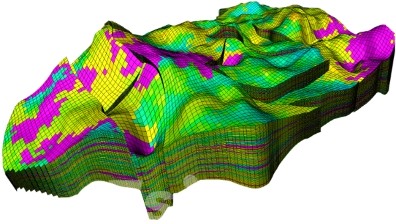
The geological model is the foundation of reservoir simulation, providing a detailed representation of the reservoir’s physical structure and characteristics.
- Structure: Defines the geometry of the reservoir, including faults, folds, and other structural features.
- Lithology: Describes the types and distributions of rock within the reservoir.
- Reservoir Zones: Identifies different layers or zones within the reservoir, each with distinct properties.
2. Petrophysical Model
The petrophysical model describes the physical properties of the reservoir rocks that influence fluid flow and storage.
- Porosity: Measures the proportion of void spaces in the rock, which affects its ability to store fluids.
- Permeability: Indicates the rock’s ability to transmit fluids through its pore network.
- Saturation: Refers to the distribution of fluids (oil, water, gas) within the pore spaces.
- Capillary Pressure: Describes the pressure required to move fluids through the rock’s pore network.
3. Fluid Model
The fluid model characterizes the properties and behavior of the fluids present in the reservoir, including oil, gas, and water.
- PVT Properties: Pressure-Volume-Temperature relationships for the reservoir fluids, essential for understanding how they will behave under different conditions.
- Phase Behavior: Describes how the fluids interact and transition between phases (e.g., from liquid to gas) within the reservoir.
- Viscosity and Density: Key properties that affect fluid flow and pressure distribution within the reservoir.
4. Dynamic Model
The dynamic model simulates the movement and interaction of fluids within the reservoir over time, considering the effects of production activities and natural processes.
- Flow Equations: Mathematical equations that describe the flow of fluids through the reservoir’s porous media.
- Boundary Conditions: Define the external limits of the reservoir model, including pressure and flow constraints.
- Initial Conditions: The starting state of the reservoir, including initial fluid distribution and pressure.
- Well Models: Represent the locations and characteristics of production and injection wells, including their impact on fluid flow and pressure distribution.
5. Reservoir Management Strategies
The simulation model also integrates various management strategies to optimize reservoir performance.
- Production Planning: Determines the optimal production rates and schedules to maximize recovery.
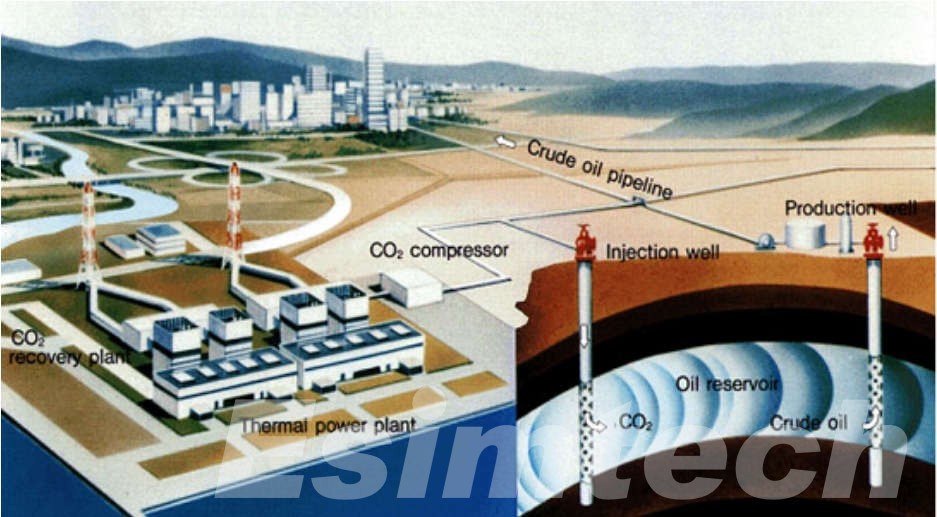
- Enhanced Oil Recovery (EOR) Techniques: Evaluates the effectiveness of EOR methods such as water flooding, gas injection, and chemical injection.
- Reservoir Monitoring: Incorporates real-time data and historical production data to update the model and refine predictions.
6. Computational Tools and Software
Advanced software and computational tools are used to build, run, and analyze reservoir simulations.
- Simulation Software: Specialized oil and gas software such as ECLIPSE, CMG, and PETREL is used to create and run simulation models.
- High-Performance Computing (HPC): Utilizes powerful computing resources to handle the complex calculations required for large and detailed reservoir models.
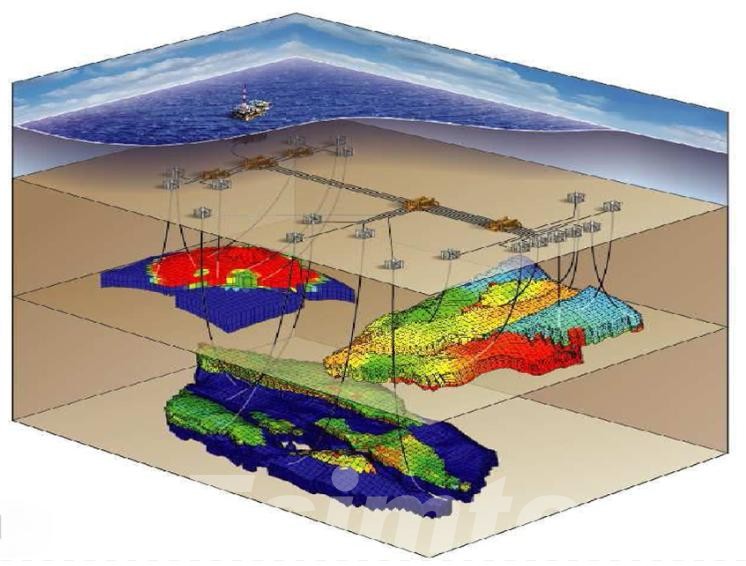
- Visualization Tools: Visual Oil and gas simulation tools help in interpreting the simulation results through 3D models, graphs, and charts, making it easier to understand and communicate findings.
Types of Reservoir Simulation Models
This chart provides a concise overview of the different types of reservoir simulation models, highlighting their descriptions, applications, advantages, and limitations.
| Model Type | Description | Applications | Advantages | Limitations |
| Black Oil Model | Simplified model assuming immiscible oil and gas phases with constant properties. | Conventional oil reservoirs. Primary recovery methods. | Simple and fast. Requires fewer data inputs. | Limited accuracy for complex fluid interactions. Not suitable for gas condensate reservoirs. |
| Compositional Model | Detailed model that considers changing fluid compositions over time. | Gas condensate reservoirs. Volatile oil reservoirs. | Accurate for complex fluid systems. Accounts for compositional changes. | Computationally intensive. Requires detailed fluid data. |
| Thermal Model | Model that incorporates the effects of temperature changes on fluid behavior. | Steam injection. Thermal EOR methods. | Accurate for thermal recovery processes. – Captures temperature effects. | High computational demands. Complex to set up and calibrate. |
| Chemical Model | Simulates the interaction of injected chemicals with reservoir fluids and rock. | Chemical EOR methods (e.g., polymer flooding, surfactants). | Enhances recovery prediction for chemical EOR. | Requires detailed chemical properties and interactions. Can be complex and time-consuming. |
| Dual-Porosity Model | Models reservoirs with naturally fractured systems, treating matrix and fractures separately. | Naturally fractured reservoirs. Carbonate reservoirs. | Better representation of fractured systems. | Complex to implement and calibrate. Requires detailed fracture data. |
Key Steps in Reservoir Simulation
These steps provide a structured approach to reservoir simulation, ensuring that models are accurate, useful, and aligned with real-world conditions. Each step builds on the previous one to enhance the understanding of reservoir behavior and optimize hydrocarbon recovery.
| Step | Description | Key Activities |
| 1. Data Collection | Gathering all necessary data to build the simulation model. | Continuously integrate new data and updating the model to reflect changes in reservoir conditions and operations. |
| 2. Model Building | Constructing the initial models based on collected data to represent the reservoir’s characteristics. | Develop geological and petrophysical models. Create fluid and dynamic models. Define reservoir boundaries and initial conditions. |
| 3. History Matching | Calibrating the model by adjusting parameters to match historical production data and reservoir behavior. | Compare simulation results with historical production data. Adjust model parameters to improve accuracy. Validate the model against observed data. |
| 4. Forecasting | Running the calibrated model to predict future reservoir performance under various production scenarios. | Simulate different production strategies and scenarios. Analyze the impact of changes in operational parameters. Estimate future production rates and reservoir conditions. |
| 5. Optimization | Using simulation results to refine and optimize reservoir management strategies for enhanced performance. | Identify optimal well placement and production rates. Evaluate the effectiveness of enhanced oil recovery (EOR) methods. Adjust operational plans based on simulation insights. |
| 6. Sensitivity Analysis | Assessing the impact of uncertainties and variations in input parameters on simulation outcomes. | Perform sensitivity analysis to identify critical parameters. Evaluate how changes in inputs affect results. Use findings to improve decision-making and risk management. |
| 7. Integration and Updating | Continuously integrate new data and update the model to reflect changes in reservoir conditions and operations. | Prepare detailed reports and visualizations. Present findings to decision-makers.Use simulation results to support strategic planning and operational decisions. |
| 8. Reporting and Decision Making | Communicating simulation results and insights to stakeholders for informed decision-making. | Incorporate real-time data and new observations. Update the model to reflect changes in reservoir behavior. Ensure ongoing accuracy and relevance of the simulation. |
Challenges in Reservoir Simulation
Even though reservoir simulation is essential, engineers are always faced with many technical and logistical constraints. Some of the major constraints facing engineers today include:
- Geological Uncertainties and Incomplete Data
The oil reservoirs lie far below ground level at depths running up to thousands of meters. There cannot be any direct measurements in such cases; engineers depend on seismic, logging, and coring data, which could be incomplete or fragmented, thus creating considerable uncertainties in terms of geomechanics. - Geology and Fluid Dynamics Complexity
There may be very complex geological formations including large amounts of faults, as well as multiphase fluid flows (oil, gas, and water). The process of simulating interactions of these fluids, especially in reactive shale or carbonate rocks, becomes extremely difficult from a physical and chemical perspective. - High Computing Power and Scalability Problems
To perform simulations for full-field models with several million grid blocks, we need extremely powerful computer systems. As the field develops and EOR methods are implemented, the complexity of mathematical problems increases exponentially, resulting in the high cost of computing equipment and lengthy simulations, which affect decision-making speed. - Dynamic Nature of Reservoirs and Updating
The reservoir is not a stationary object but constantly changes in pressure, saturation, and stresses on rocks with each barrel produced or injected into the reservoir. To integrate the information about dynamic processes and update the model without stopping work is quite problematic.
Potential Solutions
| Challenge | Potential Solutions |
| Subsurface Uncertainty | Advanced data assimilation, machine learning for uncertainty quantification, and precise tool calibration. |
| Geological & Fluid Complexity | Enhanced numerical methods, specialized multiphase flow software, and integrated geomechanical modeling. |
| High Computational Costs | High-Performance Computing (HPC), cloud-based parallel processing, and smart upscaling techniques. |
| Dynamic Behavior | Real-time data assimilation, digital twin workflows, and continuous automated model updating. |
Bridging Reservoir Intelligence with Operational Success
Though software tools such as ECLIPSE and CMG provide vital static and dynamic data about the reservoir, the actual recovery factor depends entirely on the execution of the production plans by field personnel. Poor choke management, bad well intervention, and misinterpreted well logging results can lead to the demise of any optimally designed reservoir engineering plan.
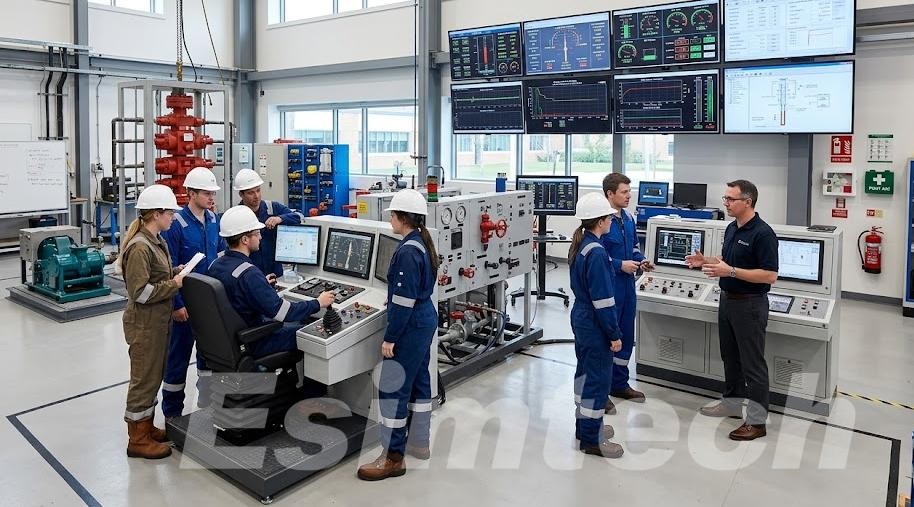
Here Esimtech’s high-fidelity physical simulator comes into play:
- Oil & Gas Production and Transportation Simulators: Trainees get a sense of how changing dynamic pressure inside the reservoir affects surface flow lines through realistic manifolds.
- Well Logging Simulators: Correct data collection is the #1 way of dealing with poor data quality. Train engineers on accurate tool manipulation for optimal data collection.
Through the combination of the intelligence of reservoir engineering with practical training of field operators, energy companies can make sure that their field operators have the right cognitive skills for reservoir asset protection.